





Today we’d like to introduce you to David Pryor.
David, before we jump into specific questions about the business, why don’t you give us some details about you and your story.
The idea for Vertigrow Produce, LLC, began in my garage back in 2016. With multiple states beginning to legalize marijuana, I became very interested in the production methods of commercial operations. The majority of the businesses that I was researching were using hydroponics in controlled environments, which fascinated me. I obviously couldn’t grow marijuana legally in Texas, but I still wanted to explore hydroponics for myself. I began in my garage with arugula seeds and built a small setup made from PVC and followed a few tutorials on YouTube to learn how to build my own LED grow light from scratch. The first system was a total failure and nothing grew quite the way I was expecting.
After re-configuring my grow light and tweaking the system’s settings, I finally got things up and running. Once the system was functioning properly, I began to realize that there is a lot of maintenance involved in keeping the pH of the water in the right range, as well as keeping up with the nutrients. I had a raspberry pi that I had been tinkering with and decided that using it to automate the maintenance of the water would be a great application. From here, I built a controller to monitor the pH of the water, and pump in an acid solution or a base solution to adjust it and keep it within an acceptable range.
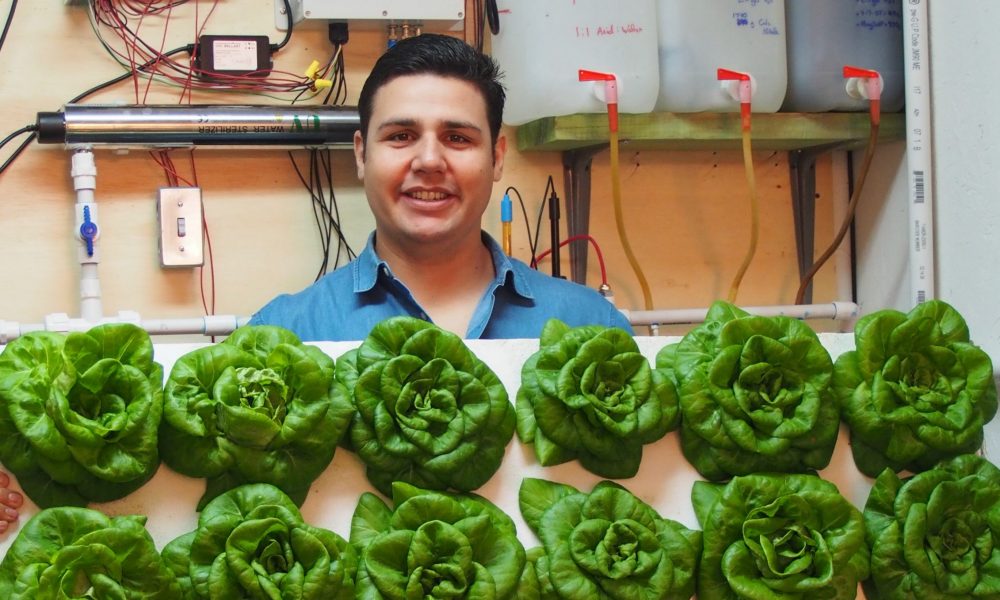
After figuring out how to build the lights, system, and an automation solution, I partnered with a friend and technologist I was working with at the time, Kip Daniels. We took the system I made and figured out a way to stack it vertically, allowing us to produce 75 heads of lettuce per week, in 20 sq. Ft of space. We built a small sealed environment in a barn that my parents own in Waxahachie. We then constructed the system and expanded the automation solution to control the AC unit and grow lights.
From here, we were off and running, growing lettuce and selling at the Dallas Farmers Market on the weekends while we worked our day jobs during the week. It quickly dawned on us that the time investment at the farmer’s market was not paying off. We would spend an entire day out there – and sometimes do well – but other times, we would barely sell anything. I quickly realized that we needed to expand our distribution into something more reliable. This is the point when we pivoted to selling to restaurants and wholesale purchasers.
Niwa BBQ in Deep Ellum was our first restaurant. I was eating dinner there one night with my family, and introduced myself to the manager (who was actually the owner) and asked if they would be interested in purchasing our lettuce. A week later, the owner and the head chef came and visited me at the farmer’s market to inspect the lettuce. They were happy with the product and even happier to work with a local business.
After working with Niwa BBQ for a bit, the chef asked, “what else do you grow?” This question caught me off guard because we had always just focused on lettuce and hadn’t really considered growing anything else. We began discussing their needs, and microgreens were brought up. We had never grown microgreens, but I was very enthusiastic about having an opportunity to grow something new. It took a lot of trial and error to get consistent production, but after a couple of months, we were up and running with an entirely new line of products. Today, we have grown over 30 different varieties of microgreens, edible flowers, petite greens, and lettuce. We have been building our client base and have continued to focus on small businesses and restaurants local to Dallas.
We’re always bombarded by how great it is to pursue your passion, etc – but we’ve spoken with enough people to know that it’s not always easy. Overall, would you say things have been easy for you?
The road has not been smooth at all. There are always new challenges (read as opportunities) that present themselves, whether those be technical or business-related.
To start with some of the technical challenges, you need to first understand that hydroponics can be simple to learn, but difficult to master at scale, and even more complex when you attempt to control all environmental variables. You now have to constantly monitor and think about the water, water temperature, light, air temperature, humidity, CO2, and airflow. For the water alone, there is not only the constant balancing of the water to ensure that the plants are absorbing minerals at an optimal rate, but you also have to worry about the microorganisms within your water. There have been times where our entire crop gets wiped out due to the dreaded “root rot”. Getting our heads wrapped around all of this took quite some time, and I am still learning every day.
On the business side, for such a small farm, it can be difficult to balance production to meet client needs. A client may order a large quantity of something one week, so we scale up production to meet their demand, and then the next week they don’t order it at all, leaving us with a large quantity of product which we must find a way to sell. The plants aren’t something that you can just make in a day or two. It can take weeks to produce certain varieties. The way I have been dealing with this has been to make sure that a strong relationship is established between myself and the kitchen staff. If I know ahead of time what they are going to need, then I can scale up or down dependent upon that.
Another substantial challenge has been the time commitment. Up until recently, I had been working a full-time job and then going from that to harvesting after work, planting on the weekends, and delivering product on my lunch breaks. It was definitely a time crunch and limited the amount of growth that we were able to achieve.
So, as you know, we’re impressed with Vertigrow Produce – tell our readers more, for example what you’re most proud of as a company and what sets you apart from others.
My company, Vertigrow Produce LLC, is a Controlled Environment Agriculture (CEA) micro-farm, located in Waxahachie, Texas, that provides sustainably grown produce to professional chefs and home cooks in the Dallas area. All of our produce is harvested and delivered within 24 hours to provide the freshest ingredients possible.
We currently produce lettuce, microgreens, and edible flowers. I would say that what I am most proud of and what sets us apart is our DIY ability, everything in our grow room has been built by us, for us. From the lights, all the way to the automation solutions. I have taken my background in data and analytics and have applied it to agriculture to create a “tech-first” agricultural production facility. With our automation solutions, we have real-time readings on all of the environmental variables which are then interpreted by our proprietary algorithms and adjusted when needed. I can control everything in the grow room remotely, so if something is really out of whack, I can do something about it. I have even made adjustments to the water while I was in Mexico on vacation.
So, what’s next? Any big plans?
We just finished the production of our newest lighting system and the results are very promising. All of our LED lights are made from the ground up using some of the most efficient components available. They are performing great, and have allowed us to cut our electrical usage in half from the previous lighting solution.
Currently, we are testing a new automation controller. Previously, we were able to monitor and control a single reservoir, which was great, but if you extrapolate that out, that means that we would need a controller for every single reservoir. To address this, we have taken our design, expanded upon it, and made it modular to allow for the control of multiple reservoirs at once, so we can keep our automation costs down.
The next phase in our plan is going to be figuring out a way to expand our production. We have the majority of operations and logistics figured out, but in order to partner with a distributor or any large scale purchasers, we will need to grow our production capability.
Contact Info:
- Website: www.VertigrowProduce.com
- Phone: 214-912-8438
- Email: david@Vertigrowproduce.com
- Instagram: @vertigrowproduce


Suggest a story: VoyageDallas is built on recommendations from the community; it’s how we uncover hidden gems, so if you or someone you know deserves recognition please let us know here.