





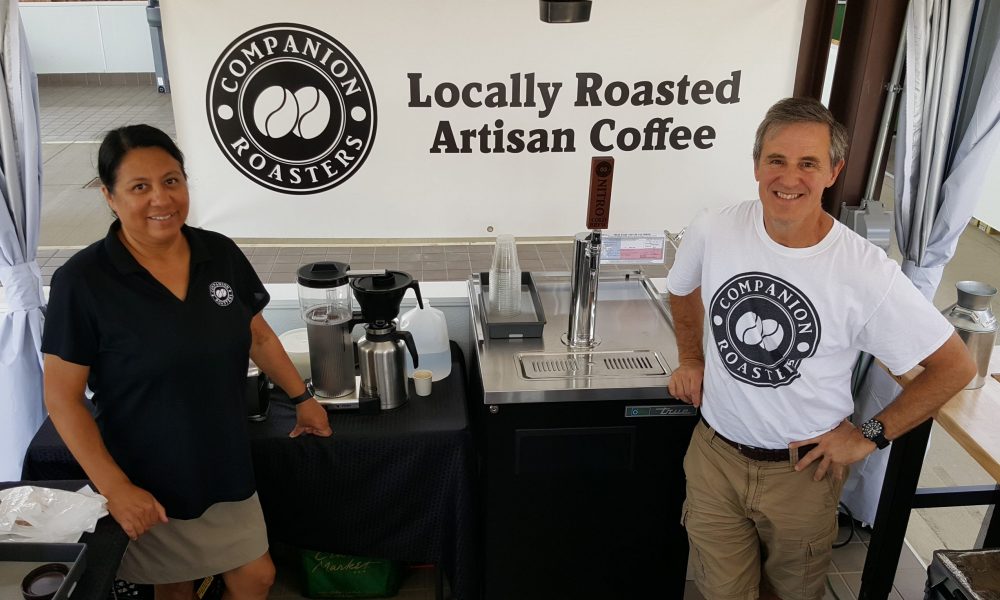
Today we’d like to introduce you to Patrick and Marian Whitsel.
Patrick and Marian, let’s start with your story. We’d love to hear how you got started and how the journey has been so far.
We’ve been drinking coffee together since we first met, but the real revelation came when-on a whim-we purchased a small home coffee roaster called the Behmor 1600. Along with the roaster came eight pounds of green specialty grade coffee from different single origins. Once we roasted these complimentary samples and got them in our cup, we were amazed at the difference in quality compared to what we had previously been drinking. Before long, we were offering freshly roasted coffee to our family and friends. The next logical step (to us) was to start a coffee roasting company. So, we began our intense study of coffee-varieties, post-production techniques, roasting profiles, etc., and shortly after, we ordered our first industrial sized roaster and set up shop, selling our coffees on the weekend at the Dallas Farmers Market. We’ve since expanded into the new Frisco Fresh Market in Frisco, Texas. Our cold brewed coffee can also be found at Royal Blue Grocers in Highland Park Village, as well as the new downtown Dallas location. We offer a seasonal selection of specialty grade beans from around the world, as well as coffees, both hot and cold, to go. Along with our cold brew offering, we have a nitro infused cold brew on tap, as well. Another popular option is the addition, for both hot and cold, of our scratch made syrups. This journey has truly been a labor of love for us, not only in working together with coffee, but also in meeting the many interesting people who also share a love for coffee.
Has it been a smooth road?
As for product, packaging, and overall image, the road has been surprisingly smooth. As in everything, though, there is a tradeoff. When we started the company, we decided that initial development would be cost effective, and that we would let the business tell us when to invest further and expand. So, we decided on incubating our business in a couple different ways. One was to operate out of a commercial kitchen, and the other was to begin selling at Farmers Markets. So, one big obstacle presented in a commercial kitchen space was finding the right kitchen that would allow installation our 5 kg roaster. This took a great deal of time and patience, but, after a year, we finally found a suitable kitchen that was being planned out and the owners agreed to accommodate us with our roaster. With our roaster now installed and running, we were finally able to proceed in our next step-selling our product directly to the customer. We chose the option of Farmers Markets because this gave us flexibility in scheduling our time and the cost of build out consisted merely of a canopy and tables. Now, if we had to give advice based on our experience, we would have to say that, while Farmers Markets have been great for the growth of our business with a rigorous education in product sales and customer service, the trade off in not initially having a “Brick and Mortar” location has been a challenge due to the extremes of weather in Texas, as well as the labor intensive setting up and tearing down of the store front. So, we have become made of tougher stuff in the process. But, as they say, “It’s all good”, and we probably wouldn’t have done it differently even if we could have.
So let’s switch gears a bit and go into the Companion Roasters story. Tell us more about the business.
So, what we do is roast, package, brew, and serve coffee-specialty grade, single origin coffee. The difference is in the quality of the cup. By that we mean the profile-it’s hi lights, notes, and finish. In order to qualify as specialty grade, a coffee must receive a cupping score of 80 or above from a licensed Q Grader. The single origin designation means that the coffee can be traced to a particular farm or coop, and is comprised of only that terroir, not a blend. Our cutoff score is 85. This ensures that the coffee will be something that really stands out for the majority of our customers. So, if we’re known for anything, it would be exceptional coffee at a competitive price point. We pay more for our beans, the best beans that we can source for the money, and that is what sets us apart from others, even some who claim to have specialty grade coffees. Growing coffee is not easy, it’s labor intensive and the market is hard. At the time of this writing, the C-Market price for coffee is $1.12. That’s for commodity grade coffee that’s traded on the stock exchange. This is barely subsistence income for most farmers. With specialty grade coffees, farmers are able to invest their labor and expertise in not only farming, but post-production techniques to produce superior coffees that bring them success for their efforts. This is better for everybody involved-from crop to cup. As a company, I think this brings us the most satisfaction, to be part of this labor of love that involves really the whole world, and to top it off, as roasters, we’re in the apex position to take that hard won elixir and introduce it to the customer, and frequently, to witness their amazement at how good coffee can taste.
How do you think the industry will change over the next decade?
According to the 2017 National Coffee Association (NCA) report on National Coffee Drinking Trends, 59% of daily coffee consumed is classified as Specialty Grade. This is the first time in the trend report’s 67 year history that more than half of the consumption falls into this specialized category. While people 65 or older are more likely to drink their coffee at home, the younger generations are driving the demand for better coffee on the go. The number of daily specialty coffee drinkers has been the strongest overall growth in the market, at 41% in 2017 over just 9% in 1999. In just the period of 2016-2017, consumption of specialty grade coffee has increased 10%. This means that more people are drinking higher quality coffee at a higher price premium. So, this points toward strong growth in the specialty coffee sector over the next 5-10 years. Also, producers are working hard to counter the detrimental effects of climate change on coffee. An example of this is finding strains of quality coffee that are resistant to Rust, a fungus that has had catastrophic effects on arabica coffee crops in the recent past. Another example of pro-active measures taken by many specialty coffee producers is sustainable practices to ensure a returnable investment over time while protecting the environment, upon which everything depends.
Contact Info:
- Website: www.companionroasters.com
- Email: info@companionroasters.com
- Instagram: https://www.instagram.com/companionroasters
- Facebook: https://www.facebook.com/pg/CompanionRoasters
- Twitter: https://twitter.com/companionroast


Getting in touch: VoyageDallas is built on recommendations from the community; it’s how we uncover hidden gems, so if you know someone who deserves recognition please let us know here.