




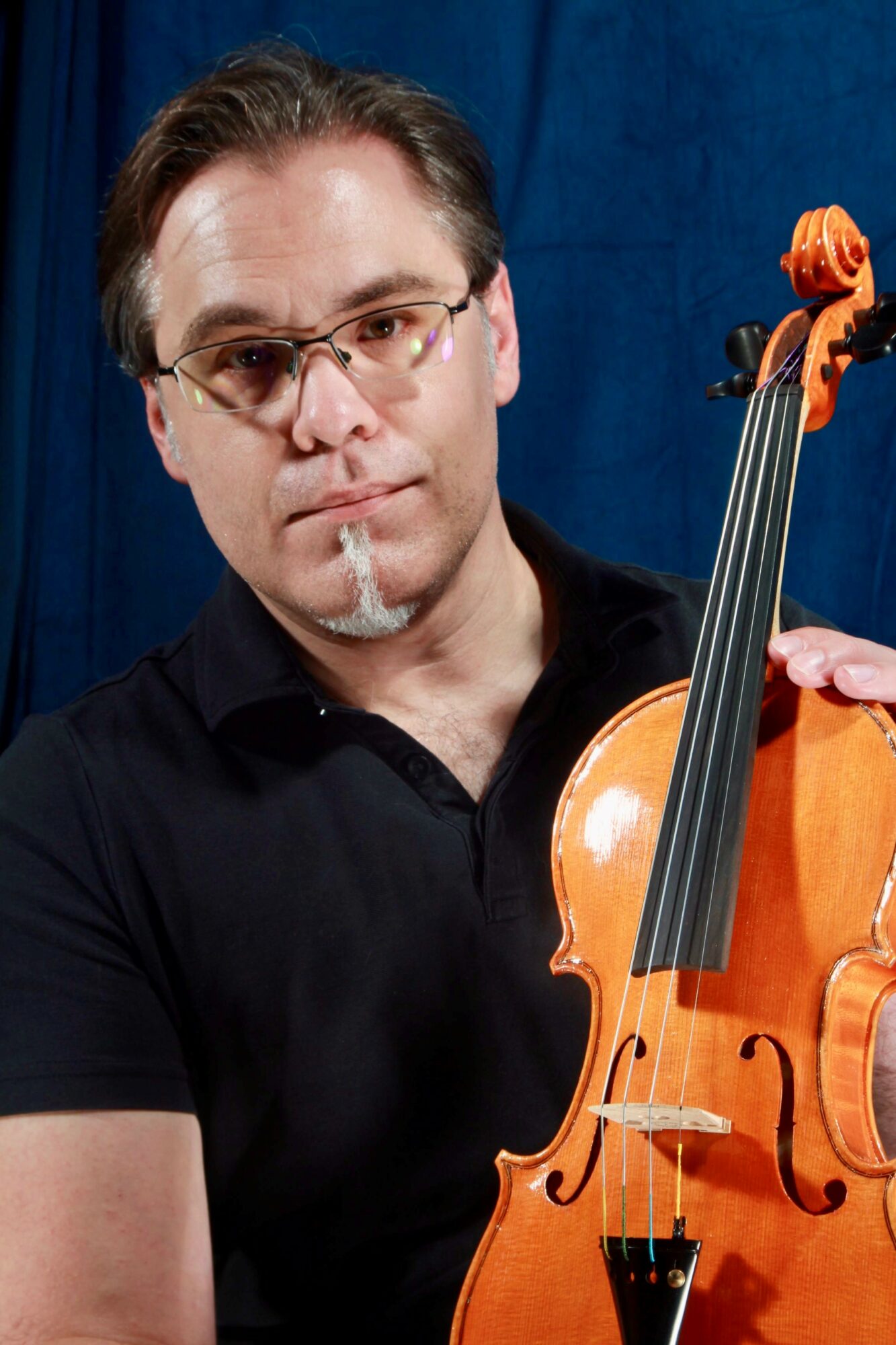
Today we’d like to introduce you to Brian Timmons.
Hi Brian, so excited to have you with us today. What can you tell us about your story?
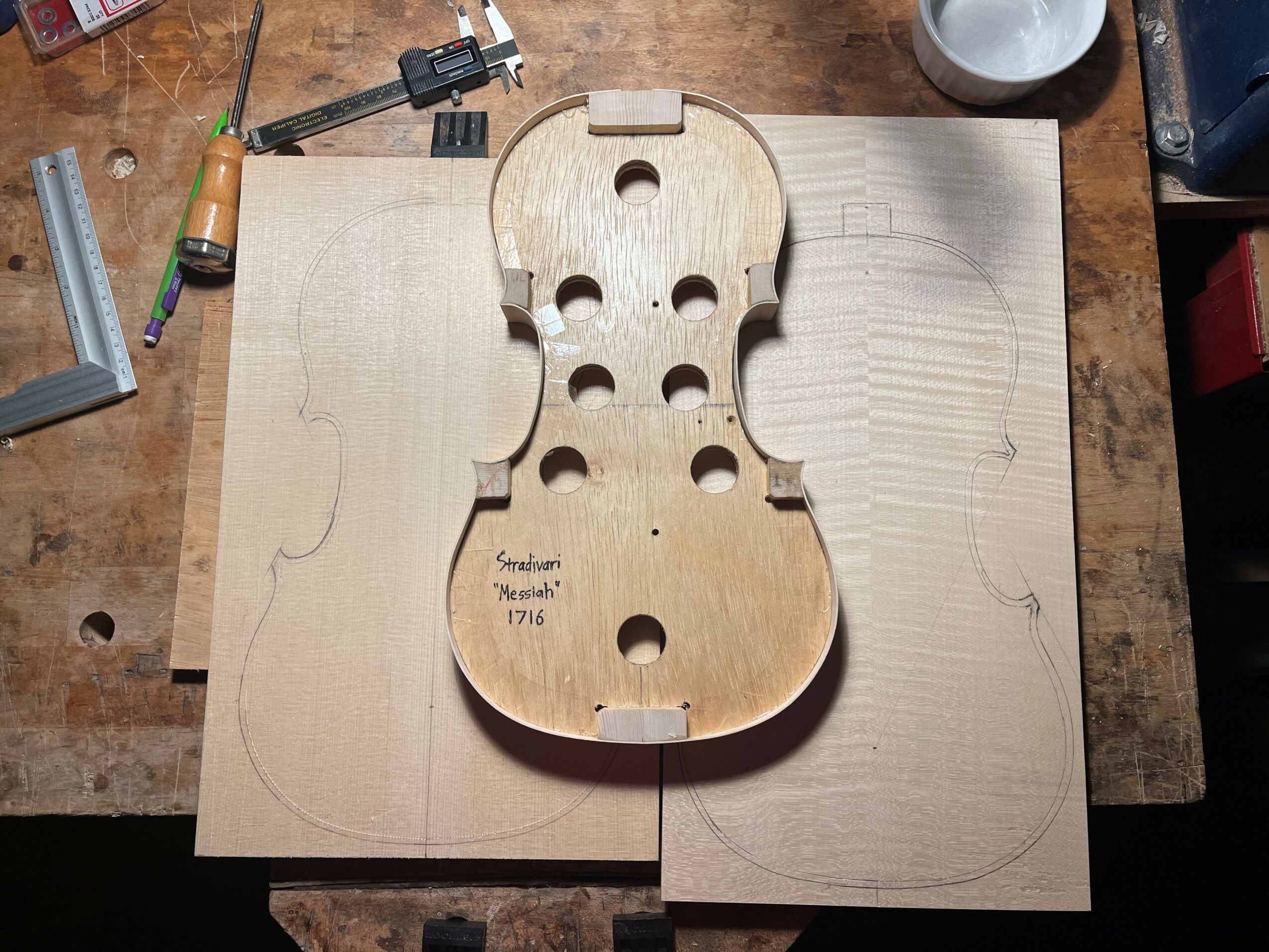
Because I’m a lunatic, I made my first violin without professional training.
That’s the short version, anyway. The real story goes back quite a way. I’ve always enjoyed creating and working with my hands. As a kid, that meant a lot of drawing and building with LEGO sets. I have some family around the El Paso area, and every time I’d visit my uncle’s woodshop there, it was endlessly fascinating. He can do things with wood that astound me.
Then there’s the musical influence. I grew up in a house where my Mom played piano and listened to classical music, and around the time I was five I asked if I could learn to play the piano. Almost instantly, my parents had me enrolled in lessons. Later, the schools in Arlington had a strings program beginning in the fifth grade. So, I picked up the cello at the age of ten. I had an advantage on most of the other kids in the orchestra, since I already knew how to read music. Still, I was never going to be the next Yo-Yo Ma. But I was a decent enough player and I really enjoyed it. To this day I still have my cello, although I’m out of practice at the moment.
I had a couple of music related jobs in Arlington after high school. First was Mr. E’s Music, which was a general music store that went out of business quite a while ago. At Mr. E’s, I met a fantastic local maker named Mike Sheriff. At the time he was working there as their string instrument repairman. I owe a lot of my inspiration to him. He taught me a little bit about instrument setup, adjustment, and maintenance. I was mostly fascinated with the skill and precision in his work. It was like everything that interested me about my uncle’s shop as a kid, combined with my obsession with music and how I like working with my hands. Mike has since gone on to establish himself as a maker of pretty high-end instruments and bows. I currently own one of his handmade cello bows.
But while I was working at Mr. E’s, I was offered a sales position at Wayne Burak & Associates, which is a specialty violin shop. Much more up my alley! There I got to see some priceless antique instruments and meet working professional players from both the Fort Worth Symphony and the Dallas Symphony. And although most of my job was sales related, I also expanded my shop knowledge while I was there. Specifically, I learned their method of oil varnishing new instruments, starting with just bare wood. My background in painting and art really came in handy for that, and I was enthralled by the process. I even got to varnish the cello that I now play while I was working there.
While working in sales at the violin shop, I had a dream of learning to make instruments myself. But the prospect of having to move across the country to one of the big three schools was too much to stomach for a homebody such as myself. I couldn’t imagine leaving all my friends and family behind. There at the shop, I came across a VHS tape that was an hour-long documentary on making a violin, and I must’ve watched it at least twenty times. My hands and my heart longed to sculpt wood into something beautiful. But not having the training or resources to do it myself, I put that dream aside. I figured at the time, perhaps in another life I could’ve done it.
I left that job to pursue college, with an eye towards a music degree. I excelled in the music classes. But unfortunately, the hard academic side of things proved to be too much for my unmedicated ADHD brain to handle, and I flunked out and came back home. I worked a few different jobs, got married, and eventually I managed to get a house and gradually built up my shop.
I didn’t pick up the aptitude for woodworking on my own until well into adulthood. I never took shop class in high school, for instance. The real impetus came when I found out that my wife was pregnant with our daughter. At the time I was an obsessive-compulsive PC gamer. It was problem that had taken over my life, to be honest. I would easily spend all day on that thing if left to my own devices. I realized that I could either be a gamer or a good parent, but I couldn’t be both. So, I quit gaming and picked up woodworking, which I’d always been interested in anyway. It was a good excuse to get into the shop to make toys for my daughter. That way, I could grow as an artist, and I’d physically have something to show for all of my efforts instead of pixels on a screen. I learned mostly from internet forums like Reddit and YouTube. At first, my work was very rough and DIY, but I had high standards for myself and I pushed to become better at what I did.
After becoming reasonably proficient with woodworking, I looked to find a way to monetize those skills. Wanting to stand out from others in the handmade scene, I developed my own line of wooden combs, of all things. I established a shop on Etsy and overnight, I was sold out of every item I had made. What a great problem to have! Shortly after I set up my own .com site and I also sold my wares in local markets. I also made cutting boards, magnetic bottle openers, serving platters, rolling pins, etc. My wife also picked up woodturning and cranked out some really nice-looking pens and safety razors and shaving brushes. This was all a side business in addition to our day jobs.
The woodworking side business came to a screeching halt when my wife was diagnosed with early-stage breast cancer in 2019. Her treatment required that I not be putzing around in the shop all the time, and I transitioned from a woodworker to a caretaker pretty quickly. She was successfully treated and hasn’t had any remission, thankfully. But I never started the side business back up again. Around that time, the handmade market was becoming too saturated, and Etsy had gone from independent to corporate. It was becoming increasingly difficult to get noticed in search results because of larger manufacturers outpacing the small Mom and Pop shops that used to make Etsy and the whole handmade market great. It felt like the right time to bow out and focus on making things for myself rather than other people.
A couple of years ago I found myself drawn to watching videos of violinmakers at work again. The synthesis of art, woodworking, and music was too much to resist. As a married dad, my life situation still precluded me from attending a violinmaking school for 3-4 years, and I really struggled with the question of trying to learn on my own. I posted on the violinmaking forum on Reddit, asking if I was downright insane for thinking of trying to learn without attending school. It really felt at the time that trying to learn on my own would be like trying to become an amateur brain surgeon.
But one fellow I became acquainted with after that Reddit post changed my mind. He was finishing up his final year at the school in Chicago at the time. He had seen some videos of my other work, and remarked that there were people in his school who were about to graduate that didn’t use their tools with the same confidence as I did. For that matter, most of the students had never picked up a plane or a chisel before they began school, so he argued that my hand tool experience was a huge boon. He said just take things one step at a time, and use forums and books to broaden my knowledge base. Granted, it would be great if I had someone looking over my shoulder as I worked, but he maintained that I had the skills to do a passable enough job to get started on my own.
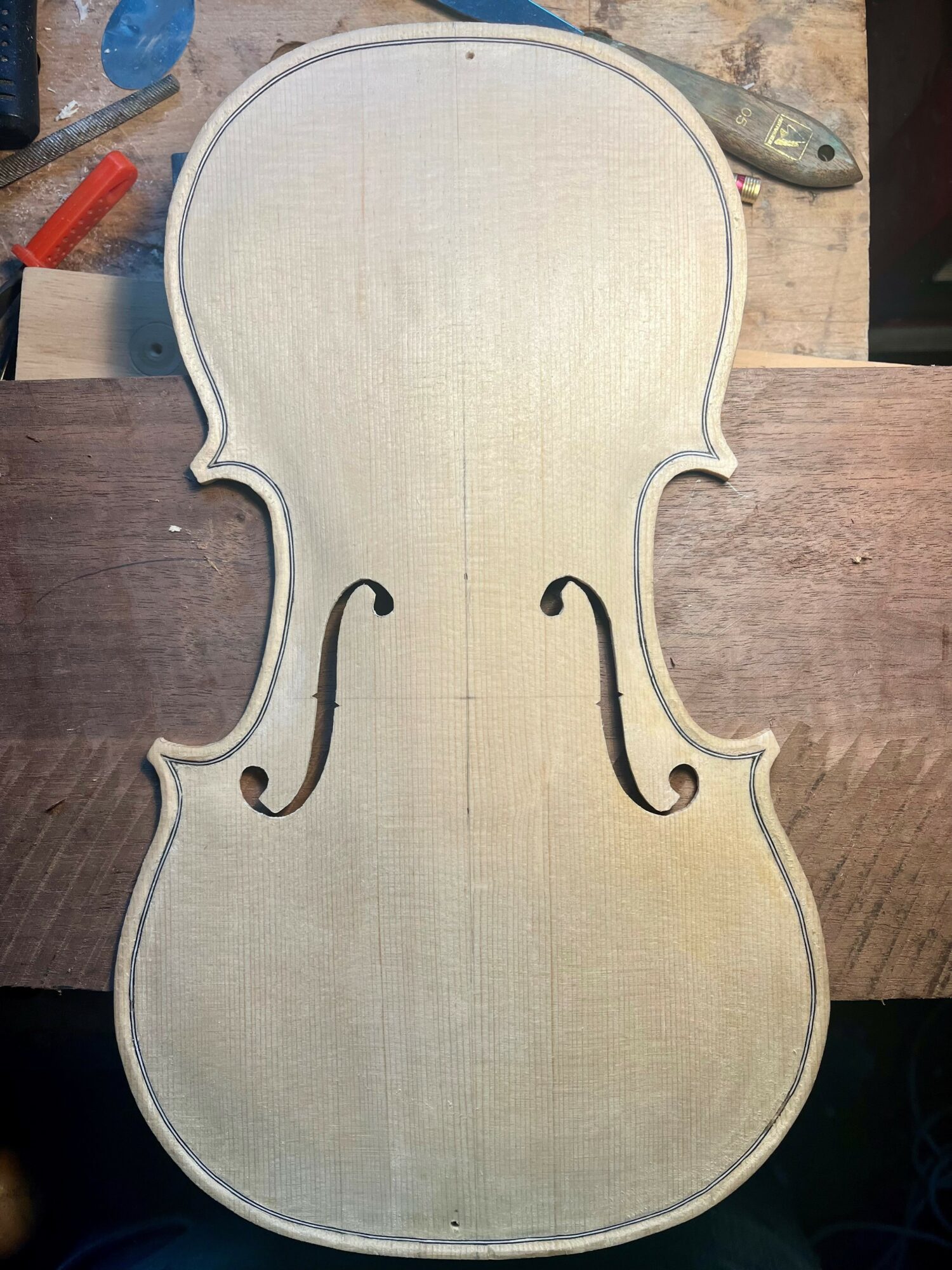
In order to make a good violin, it has to be strong enough to withstand the forces placed on it by string tension, but light enough that it resonates well. The standard woods of choice are spruce for the top and maple for the sides, back, and neck/scroll. The softer spruce top acts like a speaker cone, vibrating and moving like crazy in order to turn the motion of the strings into sound. And the stiffer maple body acts like the cabinet of a speaker, allowing the sound generated by the top to be amplified and bounced back out of the front of the instrument through the f-holes. Yes, that’s what they’re called. Make all the jokes you like about that.
To me, making a violin represented the Mount Everest of woodworking. It would take every skill I had and quite a few that I’d never done before. Although I play the cello, I decided on a violin as my first instrument for several reasons. First, because it’s smaller, the material costs are much less than a cello. Second, because of the smaller size, the work could progress faster, at least in theory. It can take 2-3 months’ worth of uninterrupted work to build a violin, and that’s if you know what you’re doing. I spent close to a year on mine, but that was done working nights and weekends where I could. Quite often I’d be too busy from my day job and running a household to get out into the shop. And when I was able to dedicate time to the violin, a lot of that time was spent reading, researching, and doubting myself rather than actually working on it. This build was quite the personal odyssey.
I’m sure it wasn’t obstacle-free, but would you say the journey has been fairly smooth so far?
The biggest obstacle I faced in this whole process was myself. I had to really wrestle with my insecurities about my lack of schooling. It almost felt disrespectful to trained violinmakers that I should attempt what they do in my home workshop. But if everyone that wanted to paint compared themselves to Leonardo da Vinci, there would be a lot less painters in the world.
That said, there were definitely a lot of physical challenges after I got over the anxieties of beginning. A major obstacle that I ran into first was getting adequate tools for the job. I already had a fair amount of tools, but almost none of them were applicable to making violin family instruments. There are a lot of very expensive tools for violinmaking, but there are often inexpensive tools that can be tweaked to work fairly well. There were a lot of research rabbit holes I went down when it came time to buy a bending iron, carving tools, sharpening stones, knives, hand planes, etc. And my funding isn’t exactly unlimited, so I was often limited by what I could afford at the time. And I didn’t purchase tools all at once, either. Lots of times my work hit a pause because I arrived at a step which I couldn’t do because I hadn’t bought the right tool for it yet.
Another obstacle was getting a good hand planed glue joint on the spruce and maple plates that make the front and the back of the violin. You’ve got to plane these surfaces absolutely dead flat and 90 degrees to each other. And if you hold the joint up to a bright light and there’s so much as a photon shining through a gap anywhere, you’ve got to start over. In order to pull this off, your tools have got to be the Platonic ideal of sharp.
Accordingly, during this build I pushed myself to become a better sharpener. I already had a pretty decent grasp of how to get very sharp edges on my tools, but I wanted to really up my game. I went back and read up and watched videos on sharpening for the first time in years just to brush up on it. I sharpen freehand on Japanese water stones, and I purchased an extra-extra fine finishing stone for the final polish. The edges of my tools glow like a lightsaber when they’re freshly prepared. During any given hour of carving or hand planing, you probably spend about a quarter of that time just touching up your edges to keep them as sharp as possible.
Becoming more adept at carving was another major challenge. I had done some relief carving before, such as lettering and some more freehand artistic patterns. But this was the first time I’ve had to carve a complex curved surface on both the outside and the inside. The plates on violins are arched in a very particular mathematical pattern called a “curtate cycloid”. First the outside convex surface is carved, and then the inside concave surface is carved to match. Special tools are used to ensure that the thickness is correct, and that you don’t leave an area too thick, or carve so thin that you punch through the other side. And the whole plate can’t be a uniform thickness, either. There are contour and thickness maps that have to be followed, because some parts of the plate have to thicker and thinner depending on where you’re measuring. This is the difficulty of creating an instrument that’s strong enough to withstand enormous pressure from the strings bearing down on it, but also making the instrument light enough to resonate and speak well. The thinnest part of a violin’s spruce top is about 2.5 millimeters thick. It’s truly staggering the tolerances that you’re working with.
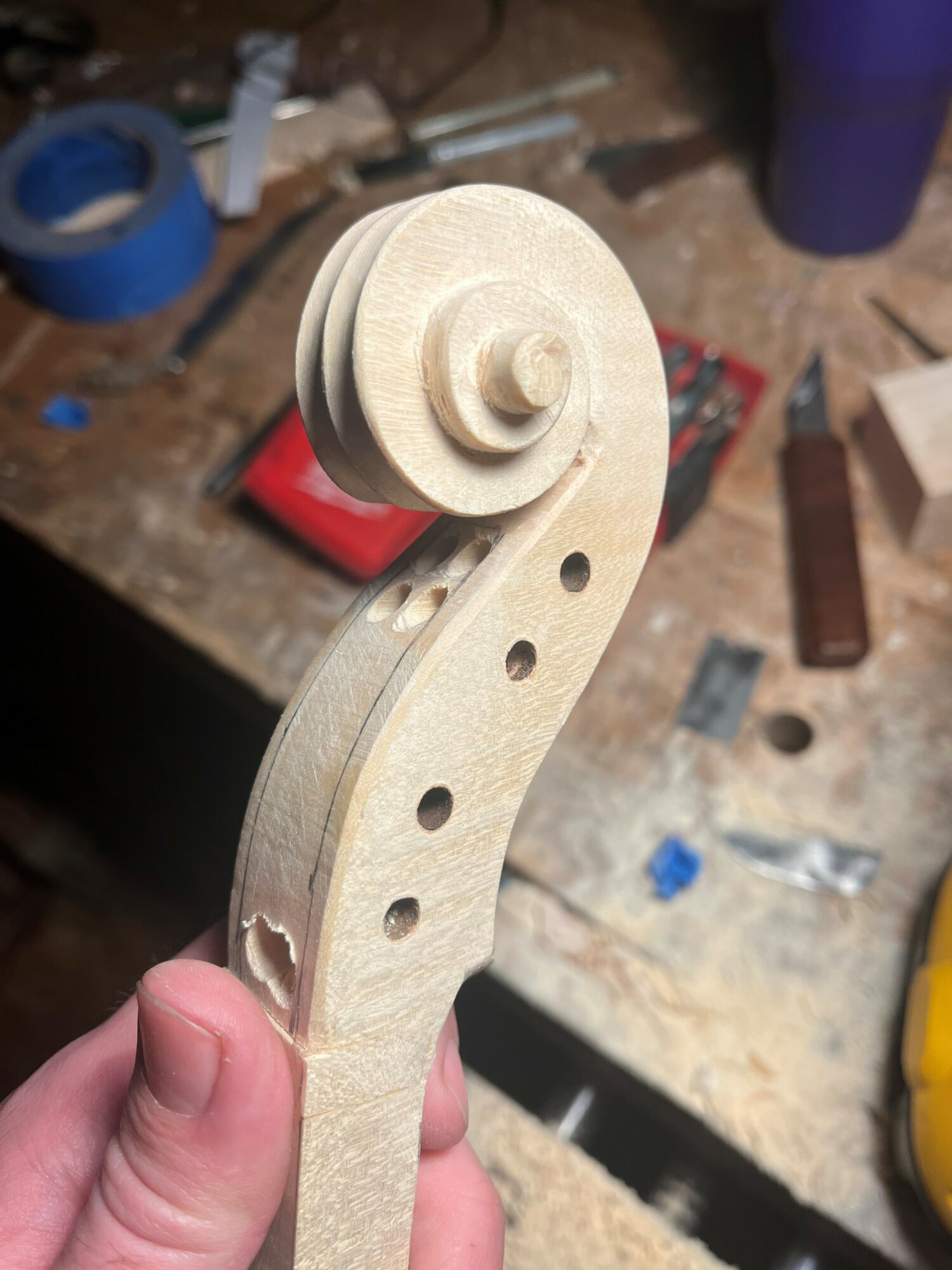
Another carving challenge was crafting the violin’s scroll. It’s part of the instrument that doesn’t serve much of a functional purpose, being mostly decorative. This was by far the most difficult carving work I’ve ever done. Working on such a small and intricate scale is one thing, but you also have to ensure that the spirals flow smoothly and that both sides are symmetrical to each other. The scroll has long been considered the artist’s signature, and there are noticeable differences among the great makers like Stradivari, Amati, and Guarneri. They all have different hallmarks, and the most trained experts can easily spot the differences. As for my scroll? Well, it looks like the first effort from an untrained amateur. But I still carved it from a formless block of maple, and I can say that it’s mine.
I had to become familiar at working with animal hide glue, which is quite the complicated subject just by itself. Violinmaking is really interesting in the sense that the techniques for construction haven’t fundamentally changed in about 300 years. And the same glue that Stradivari used is what we use today. But it’s not just tradition for the sake of tradition, that’s just peer pressure from dead people. The traditions established in violinmaking are there not because of some appeal to authority, but because they simply work, and we really haven’t found any meaningful way to improve on them. The great thing about hide glue is that it’s reversible with moisture and heat. That makes it possible to take instruments apart and work on them as time goes on. Modern wood glues are designed for a permanent bond. That’s no good. There are violin family instruments that are hundreds of years old, and they’ve all had to be worked on many times over the course of their lives. Hide glue has a solid track record of durability and serviceability. Hell, the ancient Egyptians used hide glue going back about 5,000 years ago. If it isn’t broken, don’t fix it.
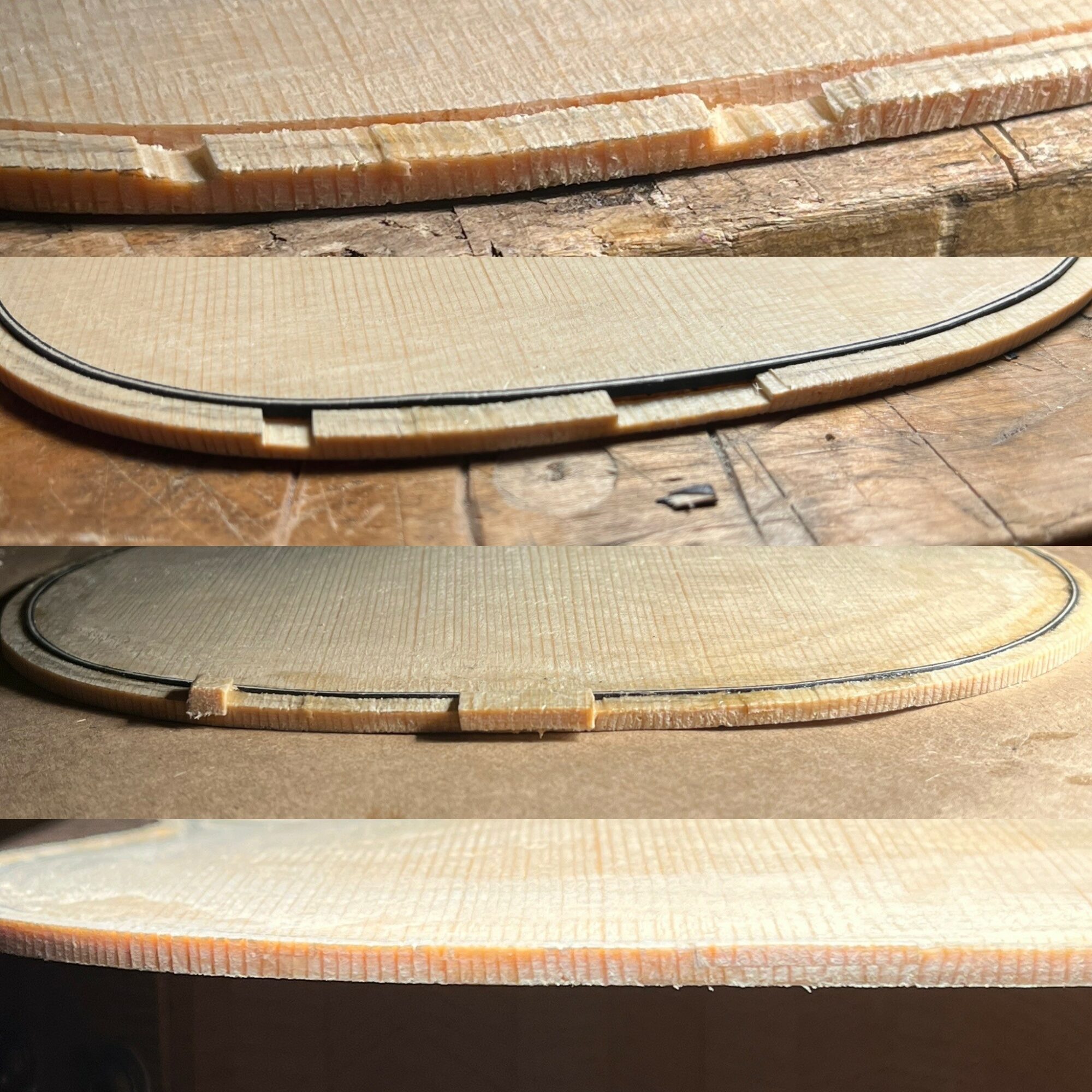
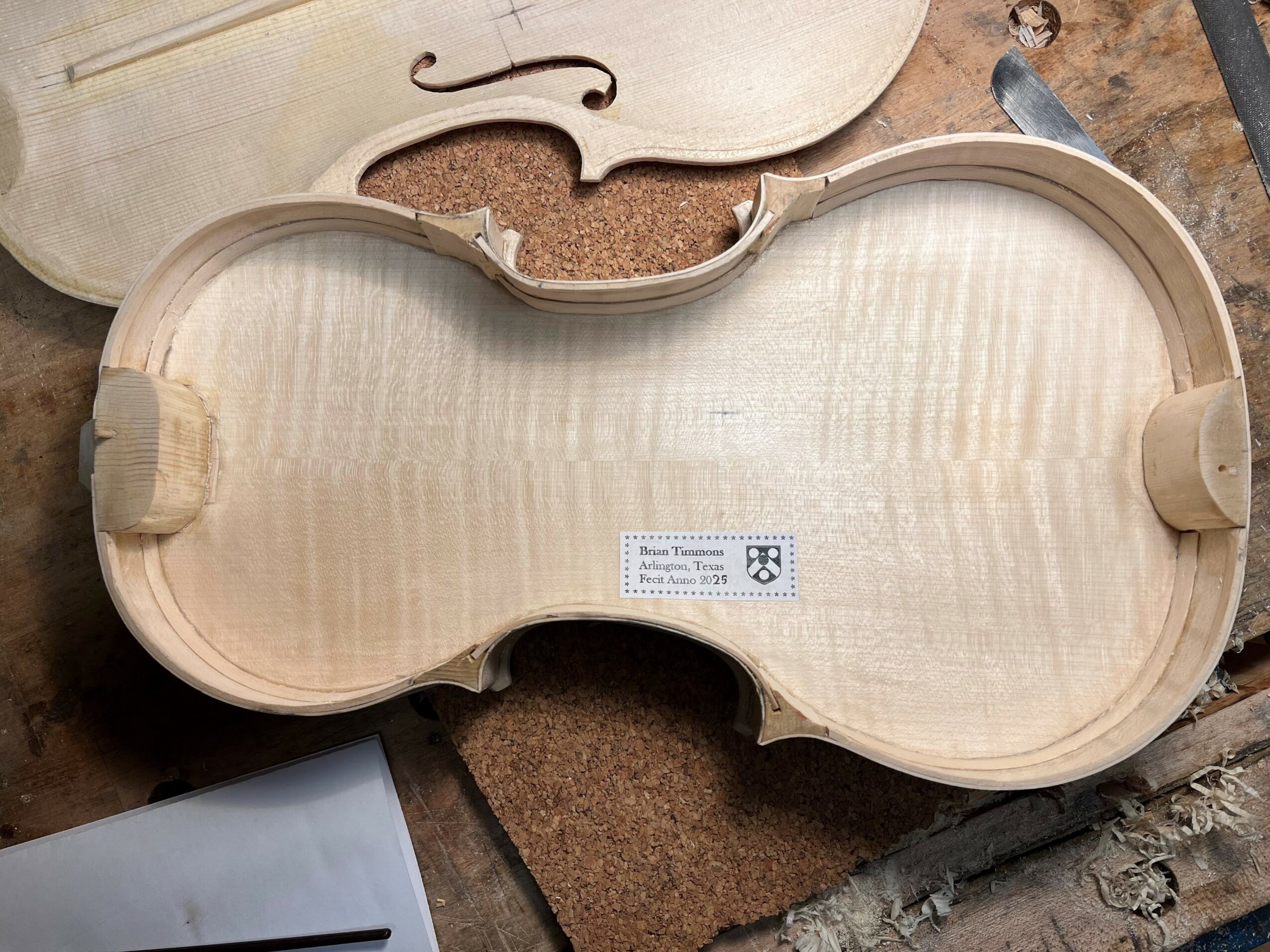
Not having a direct teacher was a major obstacle. There were plenty of times when I really could’ve used someone looking over my shoulder, saying “Stop! Don’t do that! Do it this way instead.” I had a number of accidents when working on the instrument that forced me to stop and make repairs. And not only am I a beginning violinmaker, I also don’t have repair experience, either. So, any time I’d made a boo-boo that needed fixing, I consulted internet forums with pictures of the problem, and usually I got the answers that I needed pretty quickly. I was fairly proud of how well I fixed the edges of my spruce top plate that got damaged when I was hollowing out the purfling channel. The edges had blown out and chipped in places. So, I carved out some rectilinear patches in a leftover piece of spruce and inlaid them into the damaged edges. Because of the good fit and grain matching, the patches turned out nearly invisible. I was fairly proud of that little job. (NOTE – These patches are visible in one of the photos I’ve attached here.)
Tuning the front and back plates of the violin proved to be extremely difficult. Some makers get extremely scientific about it, measuring resonant frequencies and employing all kinds of math and sound spectrum analysis. As someone that’s extremely math averse, being thrown into that realm felt like trying to land a plane with no piloting experience. Thankfully I had folks on the forums help to guide me through that process.
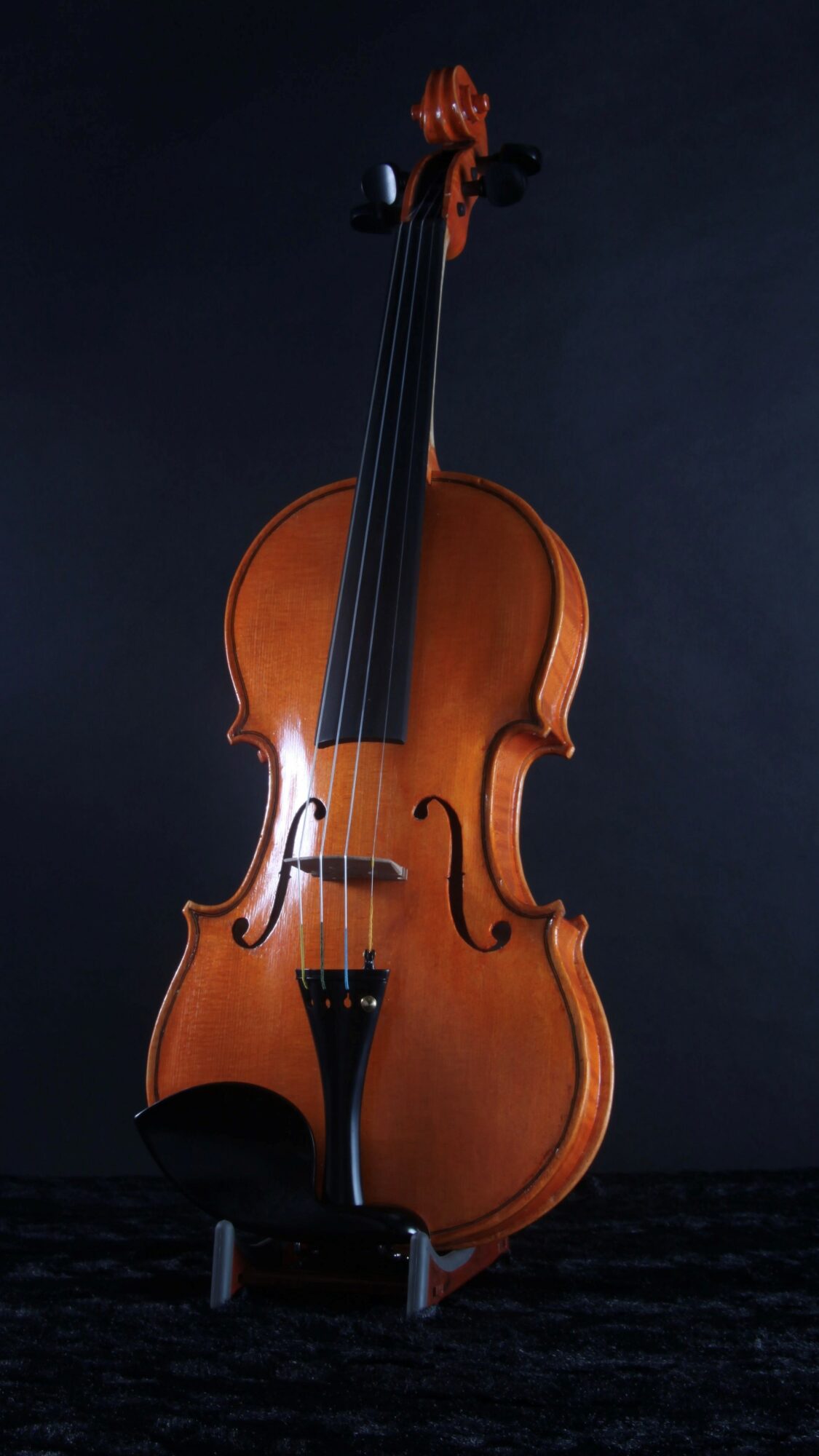
Varnishing the instrument was another major challenge. I bought a ready-made oil varnish that I couldn’t quite get good color results from. The varnish is sold as red-brown, which is what I was going for. What I ended up with is a violin that’s bright orange like a traffic cone. Even with the color additives that they sell with the varnish, I just couldn’t get the color layers to go on dark enough for my liking. I could strip it and try a different approach, but I really don’t want to go through the trouble. I’ll just be trying a different brand of varnish on my next go-around, and this time I’ll be doing lots of varnished test pieces so that I can ensure a good result on the instrument itself.
When all was said and done, I went online and found a guy in my area that was willing to evaluate the violin on video. He’s a teacher and an experienced player, having tried many instruments before, so he gave me some pretty good feedback. I asked him about the quality of the sound, and asked what he’d expect to pay for a violin that sounded like that. He said that it sounded in the range of a $2,000 instrument. If I were to sell it, for the number of hours I spent working on it, that works out to about minimum wage. That was more or less in line with my expectations. For someone that’s untrained having made only one instrument so far, I’ll accept that evaluation. That said, I won’t ever be selling this violin, anyway. I intend to hang on to it so that as I progress as an artist, I’ll have a reminder of where I started. There are a lot of small details that I got wrong on my first build, but they were all good learning experiences. Now I just have to not make the same mistakes on my next build.
Alright, so let’s switch gears a bit and talk business. What should we know about your work?
Violinmaking for me isn’t work, it’s what I do to unwind on nights and weekends. Even if I become good enough to begin selling the instruments I make, I don’t think I’d want to become fully self employed or turn it into a job. I have a Monday-Friday office job to pay the bills, and that steady income is crucial to making my life work. That’s where my head is at right now, anyway.
There is a lot of competition in the world of violinmaking, and presently I don’t have the chops to go up against professional makers. For that matter, there are some rather nice factory made instruments coming out of China these days that I couldn’t compete with on price. These instruments are made by dozens of people. One person may do the rough carving, another refines it, one person does nothing but fitting pegs, another one just makes bridges, and so on. Each of these people become quite proficient at their job, and the end result is a factory made instrument that is actually built to quite an exacting standard for a reasonable price.
But if I were to turn violinmaking into a side business, the type of musician that would be buying from me would understand that they’re purchasing an instrument made by a single local maker, and that certainly has its own charm and appeal. As it currently stands, I only have the one violin that I’ve made that I won’t be selling, and I have no other instruments for sale yet. I am currently working on a viola for a good friend of mine. Some day I’ll have to build a cello, too. I have no intention of making a double bass, though. For one thing, my shop just isn’t that spacious. Most people that make basses tend to only focus on basses. That’s a very specialized niche.
How do you think about luck?
First, I’m lucky to have an understanding wife who tolerated me wiling away my time in the shop. She understood that this was a long-standing obsession of mine, and thankfully she was willing to indulge my madness.
I’m also fortunate to already have a dedicated workspace. Not everyone who begins amateur violinmaking has the right kind of area to work out of, or a workbench, or adequate tools. I’ve seen folks on the forums that work on their kitchen table, for instance.
I’m also conscious of the sheer miracle that is the internet. Being able to ask questions on forums, read articles, watch videos, it’s all the most incredible resource to have access to. There’s a lot of nonsense on the internet of course, but there’s also a lot of really useful info if you know where to look. I’m lucky to exist at this point in history, it’s the best time ever to be an autodidact.
In particular, I utilized the patterns and templates that are freely available on https://www.makingtheviolin.com/. Another source I used is the book ‘The Art of Violin Making’ by Johnson & Courtnall. And there’s a master Italian maker named Davide Sora that has documented his entire process and made it available to watch on YouTube. His channel was greatly helpful to illustrate processes that articles and books can’t quite communicate. I sourced my wood from a company in Baltimore called International Violin. When it comes to choice tonewood that’s been air dried for at least ten years, you can’t exactly find that sort of thing in the lumber aisle of a big box hardware store.
Another lucky thing that really surprised me is how well my work has been received online. I have a YouTube channel showing how I made the violin, but the best reception I’ve gotten online has been on TikTok, of all places. The home of short attention span brain-rot videos actually has a fair amount of people that are looking for more cerebral, long form content. I get a lot of questions and comments whenever I post a video, and one video in particular has over a quarter of a million views. It’s absolutely bonkers, but it’s been pretty great overall. I love talking about this stuff to anyone that’ll listen.
But the most insane stroke of luck actually came after I finished my violin. I discovered that a great violinmaker named Ivan Bonev happens to live just three streets away from me! Ivan is also self-taught, having never gone to school for luthier training. But whereas I’ve only made one, Ivan has made something in the neighborhood of eighty violins by now. His instruments sound spectacular, and his workmanship is stunning. I’ve visited with Ivan several times and continue to do so as I work on my next instrument, which is a viola that I’m building for a good friend of mine. Ivan has been extremely generous with his time and experience, which is something I don’t take for granted. When I first met him, I brought my violin to show. He asked if I was open to constructive criticism, and I said, “That’s why I’m here, so please rip me to shreds”. So, he spent the next half hour going over my violin millimeter by millimeter addressing all of the problem areas. That kind of honest, expert feedback is priceless. If I have any kind of future in violinmaking, it’ll be because of his guidance.
All in all, it’s been a pretty wild ride. I began with an audacious idea and pushed myself beyond what was possible at the time. There were a lot of mistakes that made me nearly give up hope of being able to achieve this, but thankfully none of those mistakes were insurmountable. And although my first violin is ultimately not that extraordinary in any way, it’s mine. And it’s still something I made that I once thought was impossible. It almost takes a certain amount of arrogance to look at such a daunting artistic task and think, “I could do that”. But I think the trick is balancing that arrogance with the humility of knowing that you can always strive to do better.
Contact Info: