





Today we’d like to introduce you to Andrew Tran.
Hi Andrew, we’d love for you to start by introducing yourself.
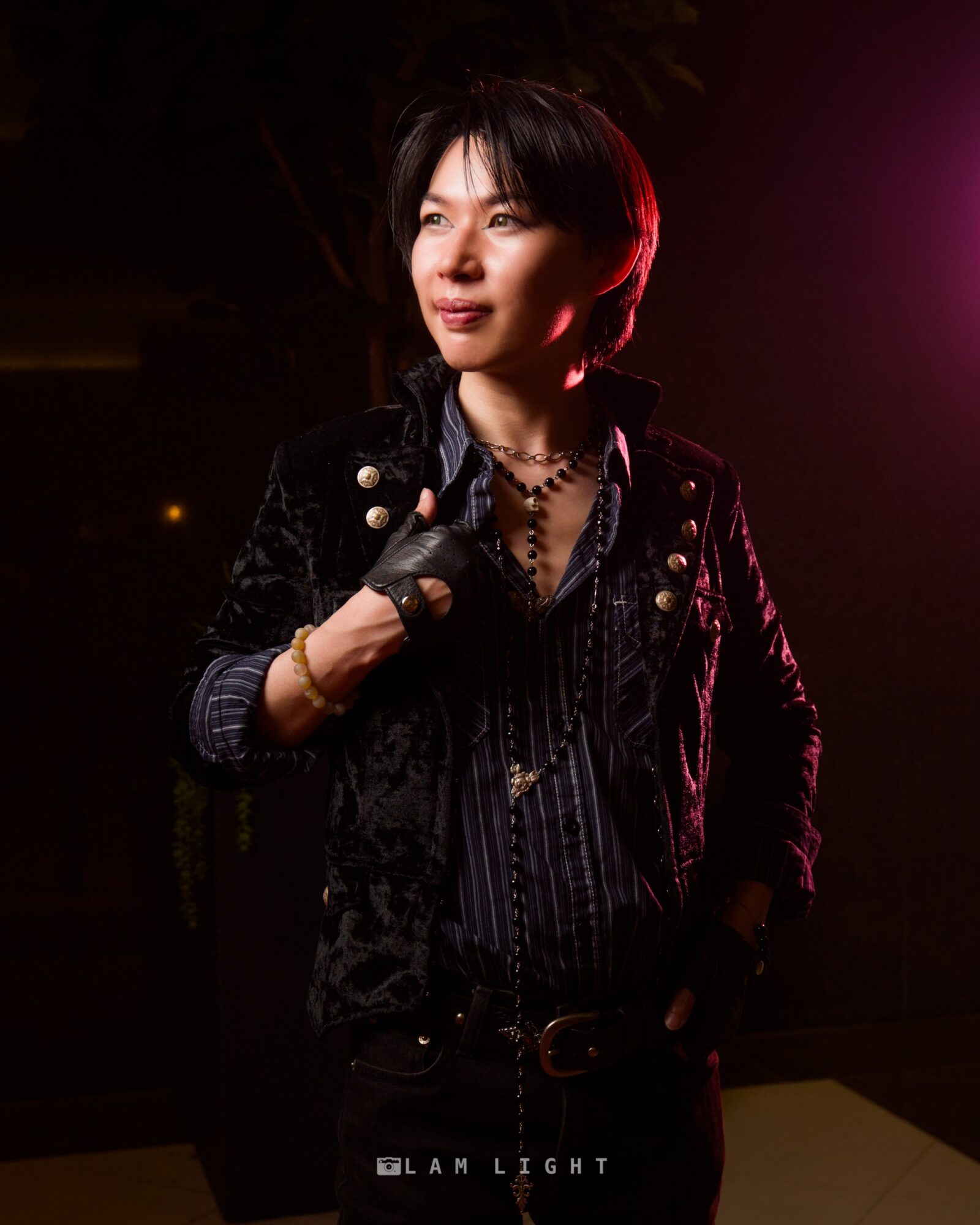
My name is Andrew Tran, founder and creative director of Truly Tranian Atelier, although many people in the fashion and creative community know me as Truly Tran.
Before there was an atelier, a fashion collection, or even the idea of building my own couture house, there was a kid with a pencil, an overactive imagination, and a fascination with creating things that didn’t exist yet.
I’ve been creating characters and imaginary worlds for as long as I can remember. My middle school science teacher, Mr. Ross, once told me, “Andrew, I bet when you were born, the doctor handed you a pencil, and then you became an artist.”
It’s a comment that has stayed with me all these years. Looking back, I think he was onto something. Although, knowing me, I probably would have complained that the pencil wasn’t sharp enough!
I’ve always had an eye for detail and a deep desire to create. I started sewing when I was thirteen, sketching wedding gowns and elaborate costumes in the margins of my notebooks, dreaming up characters, places, and stories that felt bigger than the world around me. Illustration was my first language, and sewing became my second. Together, they gave me something extraordinary: the ability to take an idea that existed only in my imagination and turn it into something tangible.
I wasn’t particularly interested in creating just another dress. I wanted to understand who would wear it, where they were going, what sort of life they lived, and perhaps most importantly, what secrets they might be hiding beneath all those beautiful layers of fabric.
Yes, even as a child, I was already being unnecessarily dramatic. Some things never change.
Historical dramas and costume films became a tremendous source of inspiration. Movies like Dangerous Liaisons (1988), Batman Returns (1992), and The Age of Innocence (1993) fueled my fascination with costume design, historical silhouettes, and visual storytelling.
I became captivated by the idea that a sleeve could reveal a secret, that embroidery could conceal symbols reflecting a character’s personality, or that an entire silhouette could tell a story before a single word was spoken. Clothing could communicate wealth, vulnerability, seduction, rebellion, authority, or heartbreak without the wearer ever opening their mouth.
That realization changed the way I looked at fashion. I stopped seeing garments as simply objects to wear and began seeing them as extensions of the people who inhabited them.
That fascination has never left me. It remains at the heart of everything I create today.
Becoming Truly
The name “Truly” began as a personal declaration during a period when I was discovering who I wanted to be, both as an artist and as a person.
I chose it because I wanted to live and create as my truest self, free from the filters, expectations, and limitations that society often places on us.
As artists, we’re frequently encouraged to make ourselves more marketable, more conventional, more agreeable, or easier to understand. There’s always somebody ready to tell you what you should design, how you should express yourself, or what the world supposedly wants to see.
Eventually, I realized that spending my life trying to satisfy everyone’s expectations would leave very little room for my own imagination.
And frankly, my imagination has never been particularly interested in behaving itself.
What began as a creative identity eventually became the foundation of Truly Tranian Atelier and the artistic universe I continue to build today.
The name represents more than a fashion brand. It represents authenticity, individuality, self-expression, and the courage to be unapologetically yourself. My passions, my style, my beliefs, and my vision are woven into everything I create.
At its core, “Truly” is a reminder that the most powerful thing we can be is ourselves.
In many ways, Truly Tranian Atelier was born from that philosophy: my world, my rules, and an open invitation for others to embrace their individuality with the same confidence.
The Bridal Years: Where Precision Became an Obsession
Before founding my atelier, I honed my craft in the bridal industry, working as an alterations specialist at David’s Bridal.
I started at the flagship store in Frisco, Texas, before transferring to the Preston location to train for a management position. Through dedication, practice, and more than a few challenging alterations, I eventually worked my way up to become the alterations manager.
It was an experience that could be incredibly rewarding and, at times, incredibly stressful. Bridal alterations are not necessarily for the faint of heart. You’re working with delicate fabrics, emotional clients, complicated construction, and deadlines that are rather famously nonnegotiable.
A wedding isn’t going to reschedule itself because your co-workers sewed a sleeve too small or a bridesmaid dress was snagged while sewing, all things I had to deal with and create solutions for.
Nevertheless, I persevered, and those years taught me some of the most valuable lessons of my career.
One memory in particular has remained especially dear to me.
A bride came in for her final fitting, but there was an unexpected complication: she was now pregnant, and her wedding gown no longer fit.
Naturally, she was worried. A wedding gown is already such a personal and emotional garment, and suddenly the dress she had chosen for one of the most important days of her life wasn’t fitting the way it was supposed to.
My teacher, Luz, who was also the previous alterations manager, and I decided that the best solution would be to create a corset back for her gown.
There was just one problem.
The gown was made of chiffon, not satin.
Anyone familiar with sewing knows that chiffon isn’t exactly the most cooperative fabric. It’s delicate, slippery, and has a remarkable talent for testing your patience. A traditional corset back could have looked bulky or completely out of place against such a soft, ethereal gown.
I wanted the alteration to be functional, of course, but I also wanted it to look as though it had always belonged there.
We saved leftover fabric from previous hems, and I gathered scraps of chiffon to create delicate loops, spaghetti ties, and a matching corset panel. Every component had to be carefully constructed to preserve the gown’s softness while providing the adjustability the bride needed.
When she returned for her final fitting, the dress fit beautifully.
I still remember the tears of joy when she saw herself in the gown.
There was something incredibly fulfilling about that moment. It wasn’t simply a matter of fixing a dress. We had taken something that had become a source of anxiety and transformed it into something beautiful again.
I was especially proud of how delicate the finished chiffon corset looked. It complemented the gown so naturally that it felt like an intentional design feature rather than an alteration.
That experience helped shape the philosophy I carry into my work today.
I often say that if I weren’t a sewist, I would have been a surgeon, because alterations demand a similar level of delicacy, precision, and understanding of structure.
To me, sewing is surgery.
You open up a garment, examine its construction, repair or reshape what needs attention, and close it again so seamlessly that the work looks untouched.
I believe a garment should be just as beautiful on the inside as it is on the outside. I hide hand-tied knots beneath seams, obsess over clean finishes, and pay attention to construction details that the average person may never notice.
Someone might ask, “Why spend so much time perfecting something nobody is going to see?”
My answer is simple: because I know it’s there.
Those invisible details are part of the integrity of the work. They represent respect for the craft, respect for the wearer, and respect for the countless hours it takes to develop a skill.
That meticulousness became one of the foundations of my brand.
Building an Atelier, One Stitch at a Time
In 2016, I transformed my experience and creative ambitions into Truly Tranian Atelier LLC, an independent couture house based in Dallas, Texas.
I often describe it as a one-visionary couture house, because the artistic direction, design philosophy, and imaginative world behind it come from a deeply personal place.
My journey into fashion has never been particularly traditional. It has been stitched together through years of obsession, discipline, trial and error, stubborn determination, and a refusal to compromise on my artistic vision.
Unlike mass-produced fashion, my atelier is built on intentional artistry. Every garment is handmade, often requiring hours of focused work. I approach each piece as something deserving of patience and care rather than something that needs to be rushed through an assembly line.
My creations include couture garments, bikinis, skirts, pants, dresses, accessories, jewelry, and handmade costumes.
But to me, they’re much more than products.
They’re stories transformed into wearable art.
From the beginning, I’ve approached fashion as both craft and storytelling. Every stitch carries intention, every garment holds a narrative, and every collection becomes another chapter in a larger universe.
I’ve always believed that clothing should be capable of making someone feel something. Whether that feeling is confidence, romance, power, nostalgia, rebellion, or the excitement of becoming somebody completely different for an evening, fashion should have the ability to transform an experience.
And personally, I think we could use a little more elegance and sexiness in everyday life.
Life is far too short to save every fabulous outfit for a special occasion.
I Don’t Just Design Clothes. I Create Worlds.
One of the most defining aspects of Truly Tranian Atelier is that I don’t simply design garments. I design characters, worlds, and entire eras.
At the heart of my creative process is what I call my Character Bible, a living archive of original characters, each with their own backgrounds, personalities, relationships, quirks, scars, ambitions, and stories.
These characters are not simply models invented to wear a particular outfit. They’re individuals within an interconnected fictional universe, and their identities help determine the clothing I create.
I consider them my muses.
Some are rebellious. Some are romantic. Some are glamorous, dangerous, eccentric, or wonderfully troublesome. They have their own personal tastes, distinctive silhouettes, and ways of expressing themselves.
Naturally, not all of them make particularly sensible decisions. But what would storytelling be without a little chaos?
Each collection begins with these characters and their evolving stories. As seasons change, new muses emerge, new realms open, and new narratives develop through fabric, silhouette, texture, symbolism, and attitude.
Sometimes I imagine an entire scene before I design the garment: the architecture surrounding the character, the music playing in the background, the way the light catches a piece of jewelry, or the expression on their face as they walk into a room.
Only then do I begin asking what they would wear.
The fictional world of Trania, including the neon-lit metropolis of Midori City, gives these characters places to live and stories to experience. The city, its culture, its nightlife, and its contrasting personalities all inspire the atelier’s evolving design language.
In a sense, my fictional universe and my fashion house continually feed one another.
The characters inspire the collections, and the collections give the characters a physical existence.
This is what sets my work apart. It isn’t simply fashion; it’s what I like to call wearable mythology.
The Tranian aesthetic blends historical romance with modern sensuality, fantasy worldbuilding with couture craftsmanship, playful camp with high drama, and character-driven design with everyday wearability.
It draws inspiration from gothic subcultures, historical costume, Asian heritage, alternative street fashion, and the theatrical possibilities of fantasy.
It’s an aesthetic where beauty is power, clothing becomes narrative, and the wearer becomes the muse.
My ultimate dream is that one day, people will connect with these original characters enough to bring them to life themselves.
I would love to see models, cosplayers, artists, and fans dressing as my characters, interpreting their personalities, recreating their outfits, and developing their own affection for the world I’ve spent so many years imagining.
Imagine walking into a convention or a fashion event and seeing someone dressed as a character who once existed only as a sketch in one of my notebooks.
I think that would be an extraordinary feeling.
Not necessarily because the character came from me, but because somebody else found enough meaning in my creation to make it part of their own creative expression.
To me, that’s one of the most beautiful possibilities of art: when something you create inspires somebody else to create in return.
Beauty With Purpose
As dramatic as my designs can be, I’ve always believed that beautiful clothing should also be functional.
A garment should serve the wearer, not the other way around.
That’s why I incorporate practical details into my couture, including hidden pockets, adjustable straps, breathable materials, ergonomic cuts, and silhouettes designed to move with the body.
I love an elaborate design, but I also understand that the person wearing it may need to sit down, walk around, dance, or occasionally retrieve their phone without performing an elaborate balancing act.
There’s a difference between a garment being theatrical and a garment being unnecessarily inconvenient.
My bikinis, for example, aren’t simply swimwear. I see them as tools of transformation. Their long, adjustable strings allow the wearer to experiment with different styling arrangements, customize their silhouette, and express their personal aesthetic.
My skirts often incorporate bold motifs, including gothic mourning hands, barbed wire, bullets, and symbolic charms. Whether they’re micro-length or floor-length, I want them to balance sensuality with strength and move with theatrical energy.
My pants combine utility and fantasy, bringing together carefully constructed seams, functional pockets, and gothic details such as embroidered cat skulls or stitched stars.
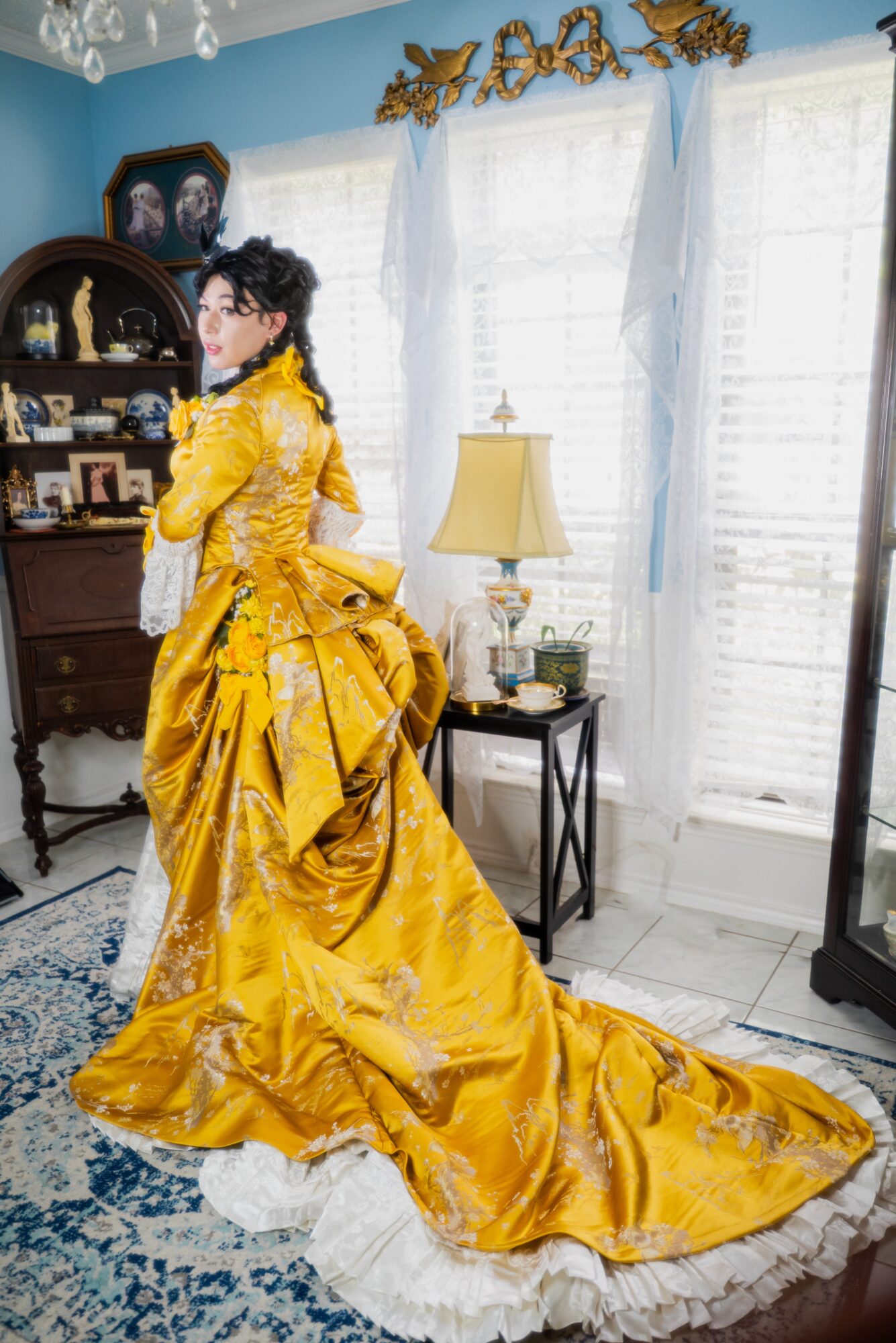
And my dresses are perhaps the most direct expression of my love for storytelling. Inspired by Edwardian refinement, Asian heritage, and gothic romance, each one is designed to feel like a character in its own right.
I often say that a Tranian dress isn’t simply worn; it’s inhabited.
The person wearing it brings the final element to the story.
All of these pieces are united by one principle: beauty with purpose.
I want my designs to be visually striking, but I also want them to have integrity, thoughtful construction, and a reason for existing beyond looking beautiful in a photograph.
Although, I certainly won’t complain if they look beautiful in a photograph, too!
The Runway: When Imagination Starts Walking
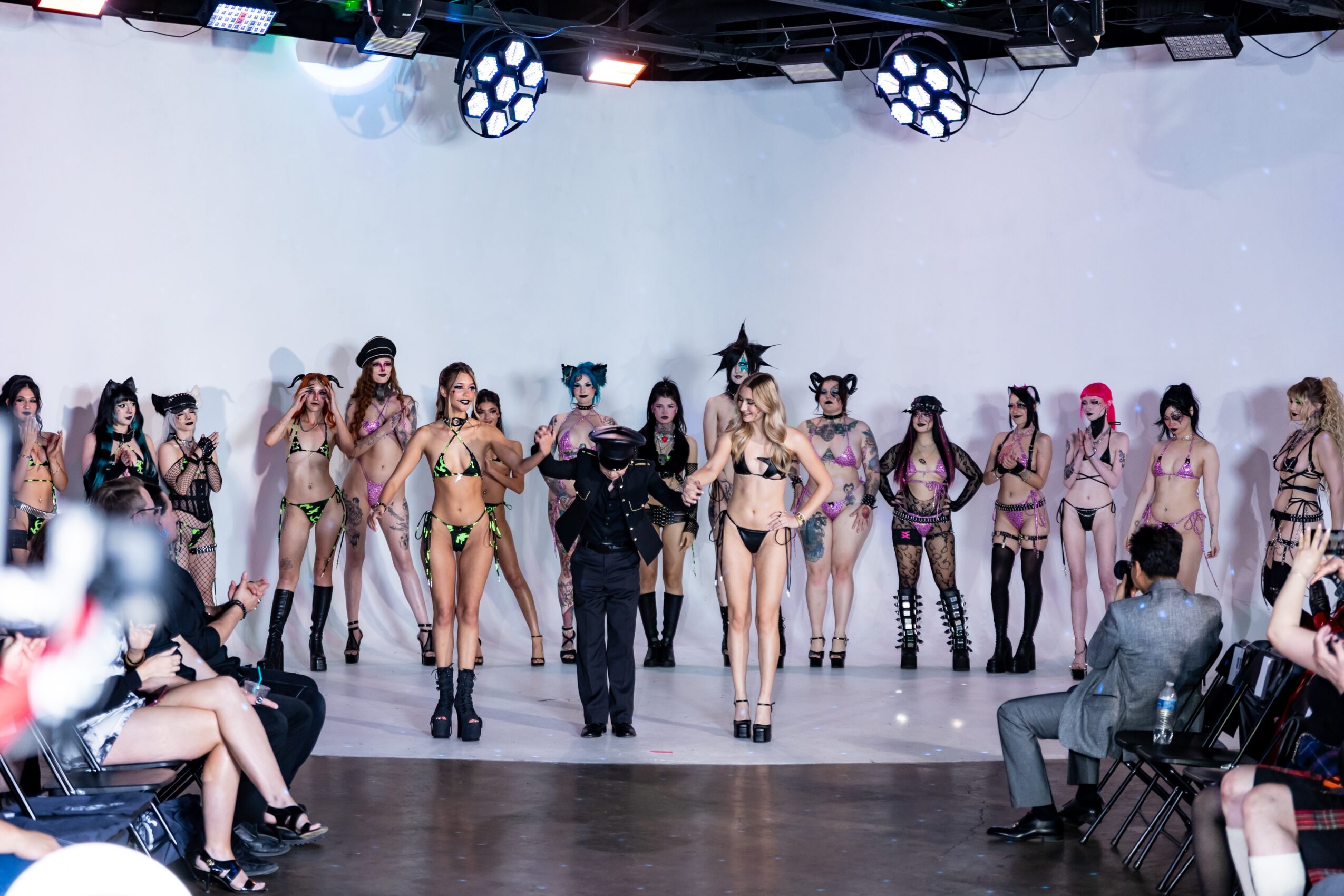
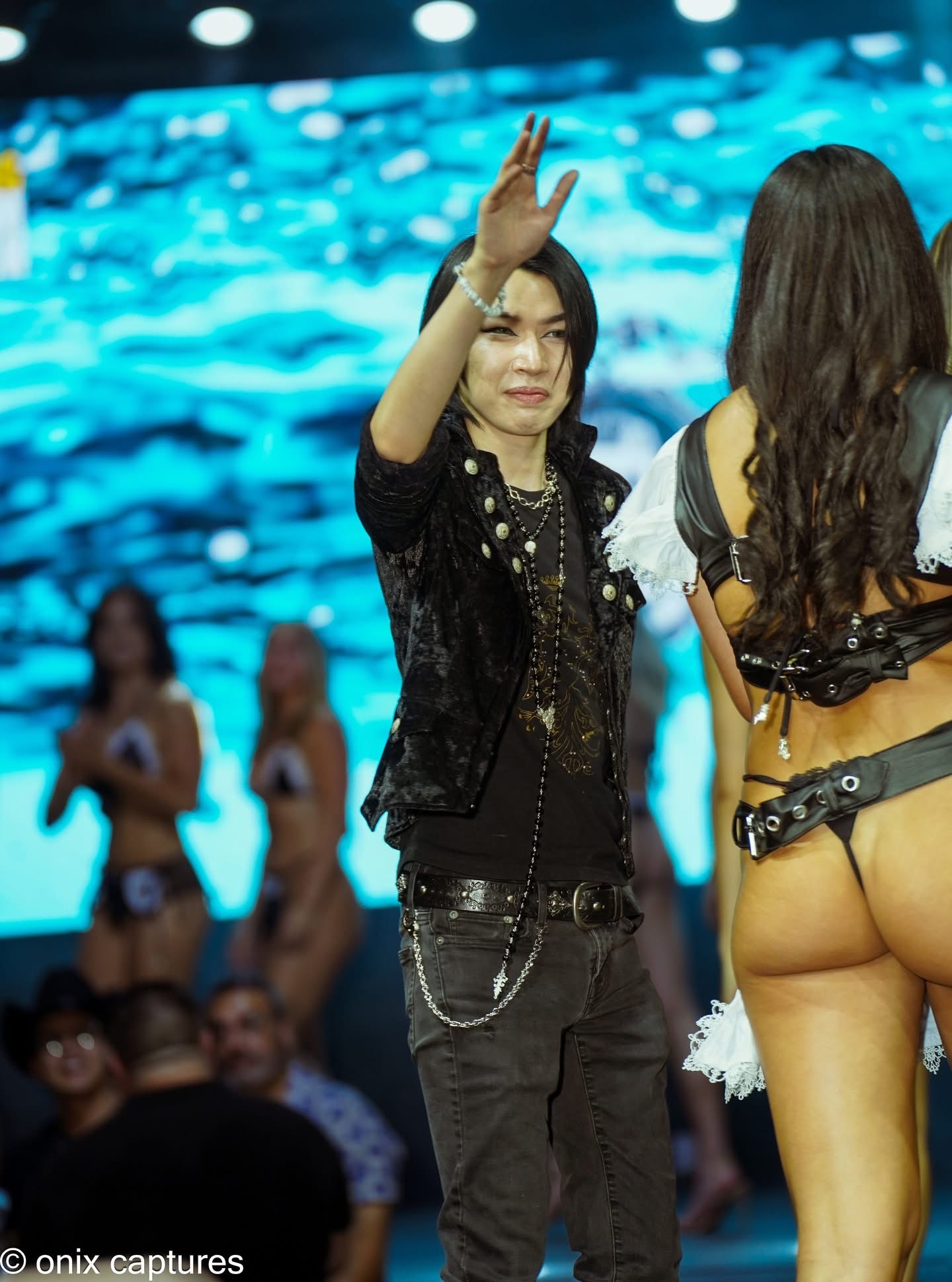
One of the most exciting milestones in my journey was having the opportunity to showcase my work at Austin Swim Week 2025, where my Gothletic Muscle Mommies collection opened the show.
The collection brought together gothic opulence, provocative silhouettes, and athletic influences, creating a theatrical interpretation of alternative swimwear.
It was only my second runway-show experience, and I genuinely enjoyed working with Santiago, his team, and the models.
Runway shows have a special place in my heart because they’re one of the rare moments when all the different parts of my creative process come together at once.
The garments, the styling, the models, the music, the movement, the atmosphere, everything suddenly becomes part of a living visual narrative.
And, of course, there are always unexpected moments behind the scenes.
I remember models walking past my clothing rack and asking whether I needed another model because they really wanted to wear my designs. They said my pieces were unique and different from what they were accustomed to wearing.
I found that rather funny, and admittedly, quite flattering.
I suppose if models are volunteering to wear your clothes before you’ve even asked them, you must be doing something right!
As luck would have it, one of the designers didn’t show up, which gave me the opportunity to send a few additional looks down the runway.
Fortunately, I had brought extra garments as backups. I’ve always believed in being prepared because, in fashion, you never quite know what’s going to happen until it’s happening.
That little bit of extra planning worked in my favor, and more models were able to wear my designs.
Another favorite memory was watching the models play around with the hand charms attached to some of my garments.
It was such a small, spontaneous moment, but it made me incredibly happy.
As a designer, I spend so much time thinking about these tiny details. I consider their placement, movement, symbolism, and how they contribute to the larger design. Seeing someone notice those details, become curious about them, and genuinely enjoy them is incredibly rewarding.
It reminds me that the effort isn’t wasted.
People do notice. Perhaps not everyone, and perhaps not every detail, but the ones who appreciate craftsmanship often recognize the love that goes into it.
Runway shows are among the accomplishments I’m most proud of.
They represent the atelier in its fullest form: countless hours of sewing, meticulous construction, creative experimentation, and a story expressed through people rather than illustrations.
Fashion shows require tremendous planning, organization, collaboration, and trust. Being able to work alongside passionate models and talented teams is something I never take for granted.
Each show is proof that something I once imagined can step off the sketchbook page and walk into reality.
And there’s something wonderfully surreal about that.
Why I Still Believe in the Human Hand
Something I’ve become increasingly passionate about is preserving the value of human-made art and craftsmanship.
We live in a world where technology allows ideas and images to be produced almost instantly. I appreciate the possibilities that new creative tools can offer, but I also believe we should be careful not to lose our appreciation for the years of dedication required to master a craft.
There’s a difference between imagining a garment and knowing how to construct one.
Learning to sew, understanding the behavior of different fabrics, mastering alterations, developing patternmaking skills, and refining your eye for proportion are things that take time.
Sometimes years. Sometimes decades. And even then, there’s always something new to learn.
When I think about the thirteen-year-old version of myself sketching elaborate dresses, I think about how much practice, frustration, curiosity, and persistence it took to reach the point where I could actually make those designs.
I think about the teachers who shared their knowledge with me, the mistakes I learned from, the garments I had to take apart and reconstruct, and the countless small improvements that eventually became instinctive.
That’s what makes craftsmanship so meaningful to me.
Human-made art carries the history of the hands that created it.
Every carefully finished seam represents knowledge passed from one generation to another. Every handmade garment contains decisions, adjustments, and imperfections that reflect the human experience of creating something.
I don’t believe technological progress and traditional craftsmanship have to be enemies. But I do believe that innovation should inspire us to value human skill more deeply, rather than dismiss the patience and discipline behind it.
I want future generations to continue drawing, sewing, painting, sculpting, writing, designing, and creating worlds of their own.
I want them to understand that it’s perfectly acceptable not to be good at something immediately.
In fact, being terrible at something is often the first step toward becoming rather good at it.
You make mistakes. You learn. You improve. You discover your own style. Eventually, you begin creating things that nobody else could have made quite the same way.
That’s the beauty of the human creative process.
My hope is that Truly Tranian Atelier will contribute to that inspiration, whether through the garments themselves, the fictional characters, or the stories behind their creation.
If someone sees my work and decides to learn how to sew, create an original character, design a costume, or express themselves more confidently, then I consider that a meaningful accomplishment.
Art should not simply end with the artist. It should inspire the next generation to pick up the pencil, thread the needle, and continue creating.
Fashion as a Declaration of Individuality
The Tranian aesthetic has always been unapologetically provocative.
It’s bold, theatrical, sensual, and intentionally designed to challenge conventional expectations of beauty and identity.
But to me, provocation in fashion has never been about shock for shock’s sake.
It’s about authentic self-expression.
I’ve always been drawn to historical periods and subcultures where clothing was more than fabric. It was armor, ceremony, rebellion, seduction, or a declaration of social and personal identity.
I enjoy taking those influences and reinterpreting them through my own artistic vocabulary.
By exaggerating silhouettes, layering symbolic motifs, and incorporating character-driven details, I create garments that invite the wearer to embrace aspects of themselves they might otherwise feel pressured to hide.
The dramatic. The sensual. The strange. The romantic. The rebellious. The wonderfully eccentric.
Fashion can give people permission to explore those qualities without apology.
And I think there’s something empowering about putting on an outfit and feeling like the most interesting person in the room, even if you’re only going out to buy a coffee.
Why shouldn’t everyday life have a little theatrical flair?
I don’t believe elegance and sexiness should be reserved for special occasions or dictated by someone else’s standards of what is appropriate, fashionable, or desirable.
One of my goals as a designer is to bring both back into everyday life, in ways that allow people to define those qualities for themselves.
I want my clients to feel confident, distinctive, and comfortable expressing their individuality.
When someone wears Truly Tranian, I want them to feel as though they’re stepping into a story in which they are the central character.
Because ultimately, they are.
The Story Is Still Being Written
When I look back at my journey, from a young boy drawing wedding gowns in his notebooks to founding my own atelier, managing bridal alterations, and presenting collections on the runway, I realize that none of it happened overnight.
There have been challenges, uncertainties, mistakes, and moments when the path forward wasn’t especially clear.
Building an independent fashion brand takes tremendous dedication. You’re not simply designing clothes. You’re learning how to manage time, materials, production, finances, expectations, and an endless collection of responsibilities that don’t always appear in the glamorous photographs.
Some days you’re the creative director imagining the next collection.
Other days you’re the seamstress repairing a stubborn seam, the production manager trying to organize everything, and the person wondering where on earth you left your scissors.
Usually, the scissors are right in front of you.
But through every challenge, I’ve remained committed to the same philosophy that inspired me to choose the name Truly in the first place.
Create authentically. Respect the craft. Remain curious. And never allow someone else’s expectations to determine the limits of your imagination.
I don’t consider my story finished. Not even close.
There are still so many garments I want to create, characters whose stories I want to tell, worlds I want to develop, and collections waiting to become reality.
I hope that as Truly Tranian Atelier continues to grow, people come to recognize it not simply as a clothing brand, but as an artistic universe built on individuality, craftsmanship, and storytelling.
I would love for people to appreciate the characters I’ve created, connect with their stories, dress as them for fun, and bring them to life through cosplay, modeling, photography, and their own creative interpretations.
I want the atelier to become a place where fashion and imagination continually inspire one another, where original characters give birth to collections and those collections introduce new people to their stories.
And perhaps, someday, a young artist will come across one of my designs and feel the same excitement I once felt watching those elaborate costumes in the films that inspired me.
Maybe they’ll pick up a pencil. Maybe they’ll learn to sew. Maybe they’ll create something far more extraordinary than anything I could have imagined.
I think that would be a beautiful legacy.
I am proud of the journey that has brought me here, but I’m even more excited about the stories I haven’t told yet.
After all, I didn’t spend all these years building an imaginary universe just to stop at one chapter.
And if there’s one thing I hope people take away from my work, it’s that creativity isn’t about fitting into somebody else’s world.
It’s about having the courage to create your own.
My message has always been simple:
Your style is your story, wear what truly makes you.
Alright, so let’s dig a little deeper into the story – has it been an easy path overall and if not, what were the challenges you’ve had to overcome?
A smooth road? Oh, absolutely not! But then again, I don’t think I’ve ever been particularly interested in taking the easy route. If anything, I’ve always had a habit of finding the road less traveled, wandering a little too far down it, and deciding to build an entire imaginary civilization somewhere along the way.
As an alternative Asian American designer, my journey has never followed the traditional path, and I never wanted it to. I’ve carved out a world where couture, character, and creativity collide, and I hope my work inspires others who feel like they exist just a little outside the lines.
For years, I felt like a tortured artist. My worlds were too strange, my characters too vivid, my details too obsessive for most people to understand. I often found myself wondering whether there was an audience for the things I wanted to create or whether I was simply destined to spend my life surrounded by elaborate sketches, unfinished ideas, and an increasingly unreasonable collection of fabric.
Being an independent designer with a very particular artistic vision isn’t always glamorous. People see the finished photographs, the runway shows, and the beautiful models wearing elaborate garments. What they don’t necessarily see are the hours spent drafting patterns, making corrections, sewing intricate details, and occasionally questioning why I decided a particular design needed yet another decorative element.
Of course, five minutes later, I’ll usually decide it needs three more.
That’s the peculiar relationship I have with my work. I am meticulous, sometimes to an almost ridiculous degree, but it’s precisely that obsession with craftsmanship and detail that gives Truly Tranian Atelier its identity.
One of the greatest challenges has been learning how to remain faithful to my artistic vision while building a business in an industry that often rewards conformity, convenience, and commercial predictability.
When you’re creating something unconventional, people don’t always know what to make of it. Sometimes they want to categorize you, compare you to an existing brand, or encourage you to make something more familiar.
But I’ve never wanted Truly Tranian Atelier to become a diluted version of somebody else’s aesthetic.
I don’t follow trends simply because they exist. I want to create something that has its own identity, its own history, and its own reason for existing.
That doesn’t mean I reject the fashion industry or the importance of understanding it. Quite the opposite. I study it carefully because I believe a designer should understand the world around them before deciding how they want to respond to it.
But understanding the rules and choosing to follow every single one of them are two very different things.
For me, being an artist has always meant accepting the possibility that not everyone will understand what I’m creating, and learning to be comfortable with that.
With stubborn dedication and relentless hard work, I eventually found others who see what I see, people who appreciate the intensity, the craftsmanship, and the mythology stitched into every piece.
Together, we’ve built a community that celebrates beauty in the dramatic, the mythic, the strange, and the intentional.
That is the Truly Tranian lens.
Finding the Right People to Bring My World to Life
Another important lesson I’ve learned is that building a creative brand isn’t simply about finding people who look beautiful wearing your clothes. It’s about finding people who genuinely understand the energy and personality behind them.
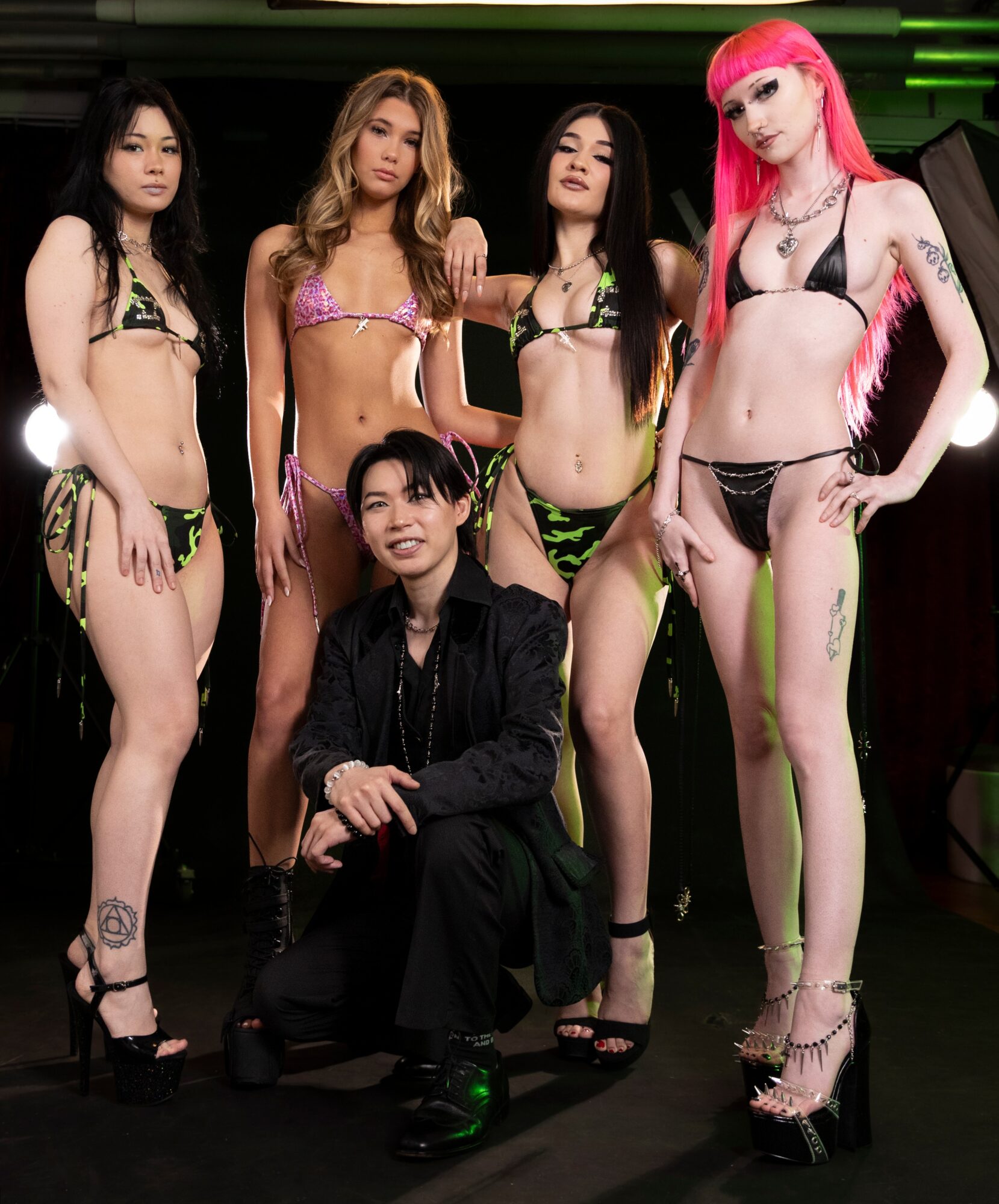
I hand-pick my models with intention. Their enthusiasm, energy, and personality matter to me as much as their look. I choose people who embody the aesthetic, who enhance the brand simply by being themselves, who step into my world and make the characters breathe.
The Tranian universe demands presence, passion, and authenticity, and when the right muse wears a piece, the story comes alive in a way fabric alone never could.
I’ve always believed there is an enormous difference between a model simply wearing a garment and a model truly inhabiting it.
A beautiful photograph is wonderful, of course, but I want something more than a beautiful photograph. I want personality. I want attitude. I want the model to understand that they’re wearing something that belongs to a larger story.
Sometimes it’s a particular expression, an unexpected pose, or the way somebody plays with the accessories on a garment. Those small, spontaneous moments can reveal more character than the most carefully rehearsed presentation.
For me, the magic happens when the model brings something of themselves into the work.
It’s a collaboration between the person who imagined the garment and the person who gives it movement, confidence, and life.
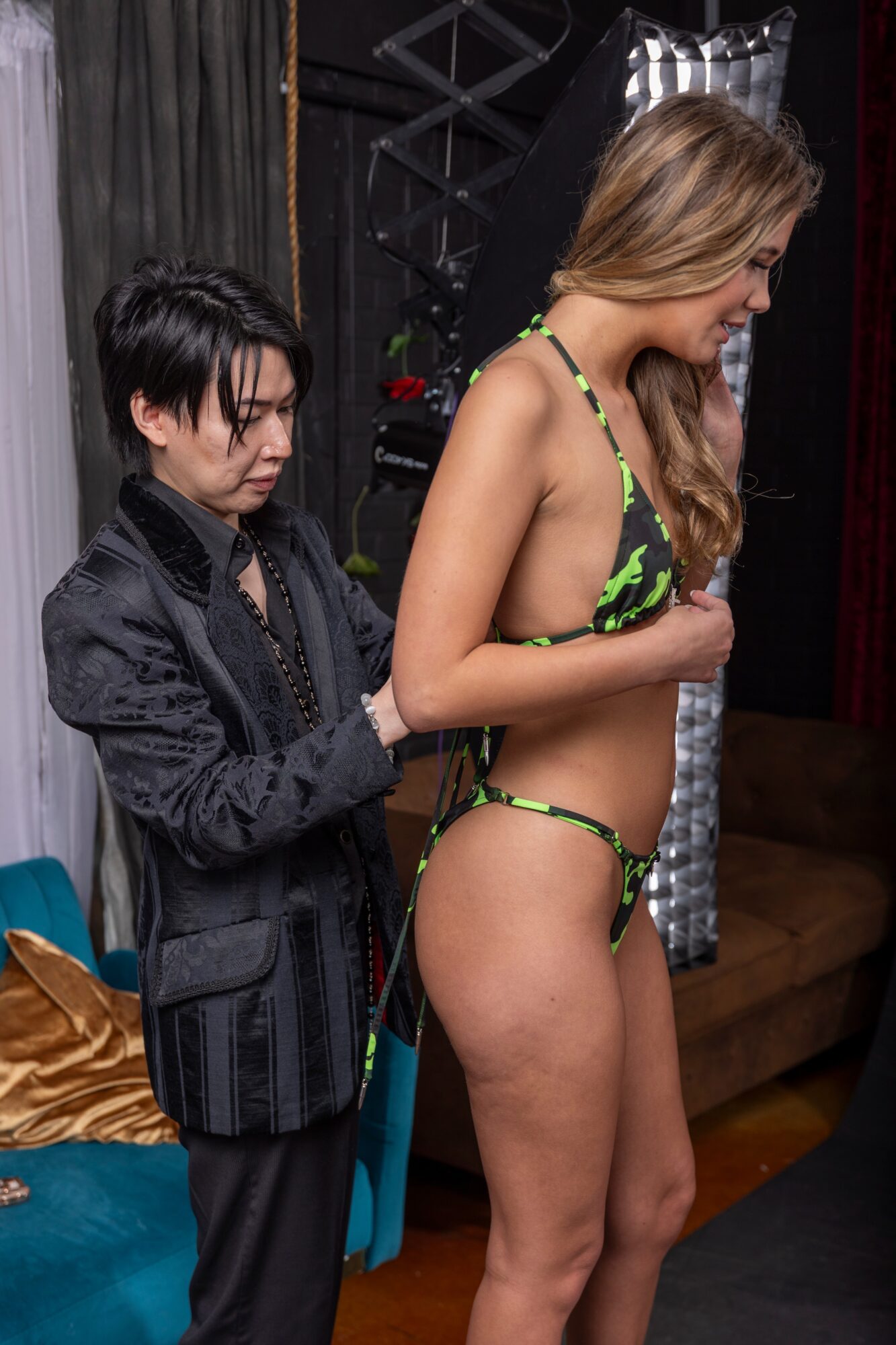
And yes, I can be very particular about the details. I have been known to fuss over the placement of an accessory or the arrangement of a bikini string because I know exactly how I envisioned the final look.
I suppose that comes with the territory when you’re simultaneously the designer, storyteller, and slightly overprotective parent of an entire fictional universe.
But that attention comes from a place of respect for the work and for the people who help bring it into reality.
Finding the right creative collaborators takes patience, and learning how to communicate a highly specific artistic vision is a skill in itself.
I’ve learned that the best collaborations happen when people don’t simply execute your vision, they genuinely enjoy becoming part of it.
Accepting That My Style Isn’t for Everyone
One of the harder realities of working in alternative fashion is accepting that your work will not appeal to everyone.
But my style isn’t for everyone. It’s bold, specific, and unapologetically its own universe.
For those who connect with it, though, you feel the story, the symbolism, the worldbuilding stitched into every seam. You see yourself in the characters I create, and you carry the same fire I had when I first started sketching at age ten, dreaming of worlds bigger than my own.
I’ve come to understand that individuality is not necessarily about achieving universal approval.
Sometimes the very qualities that make your work difficult for one person to understand are the same qualities that make another person fall completely in love with it.
And I think that’s beautiful.
There will always be people who prefer something understated, conventional, or easily categorized. There’s absolutely nothing wrong with that. Fashion is deeply personal, and everyone deserves the freedom to dress according to their own tastes.
My work simply happens to lean toward the dramatic, provocative, gothic, romantic, and occasionally wonderfully absurd.
I love silhouettes that command attention. I love symbolism that rewards a closer look. I love combining historical elegance with contemporary sensuality and allowing humor, fantasy, and rebellion to exist within the same garment.
What I don’t want is to create something merely because I think it will offend the fewest people.
That would feel like betraying the very reason I began creating in the first place.
I’ve had to learn that being misunderstood is not necessarily the same as being unsuccessful. Sometimes it simply means you’ve created something that doesn’t fit neatly into an existing category.
And if there isn’t a category for what I’m doing, perhaps I’ll just have to invent one.
After all, I already invented an entire fictional world. What’s one more category?
Taking Risks: Tranian Artillery — Military Monster Girls
Risk has always been relevant in the creative field. In turbulent times, a collection can make or break a brand.
As a designer, you’re constantly making decisions about which ideas deserve to become reality. Some concepts are beautiful and relatively easy for people to understand. Others are more complicated, provocative, or uncomfortable.
Sometimes you have to ask yourself whether you’re willing to stand behind an idea even when you know it may challenge people’s expectations.
My biggest risk was choosing to create a collection that touched on themes many designers avoid: Tranian Artillery — Military Monster Girls.
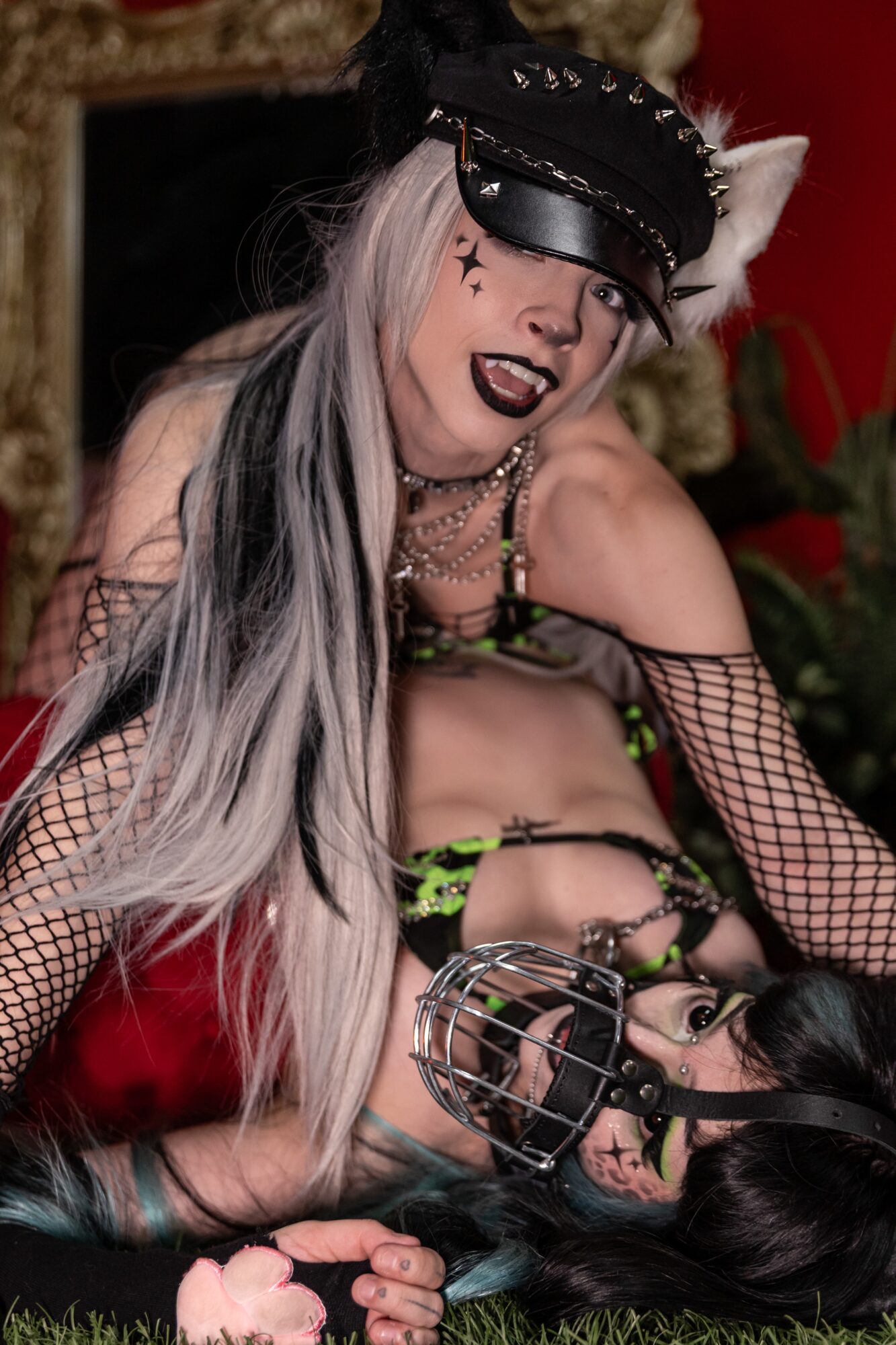
This collection was a battalion of stitched-up sirens and snarling silhouettes, forged from the fallout of conflict and couture. Each look was an anthropomorphic howl: war as a rabid muse, femininity weaponized, trauma worn like medals. These girls didn’t flinch, they bit. Their scars were stitched with pride, their posture was post-apocalyptic poise, and their bark was only the beginning.
Tranian Artillery doesn’t ask for peace; it parades through the wreckage in platform heels and tactical glam, reminding us that when war makes dogs of us, we might as well be beautiful beasts.
It was deliberately theatrical, macabre, and confrontational. I wanted to explore the relationship between military imagery, fashion, identity, and the darker sides of human nature without sacrificing the camp sensibilities that define much of my work.
The inspiration came from a single image: a snarling dog inside a star-shaped hole.
To me, it represented the hostility of patriotism and the dark side of military fashion. I transformed that vision into camp, macabre details, white stitched cat skulls on skirts and pant pockets, silver bullets, barbed wire, and gun charms.
Those details weren’t included simply because they looked edgy or unusual. They were part of a visual language intended to communicate the collection’s themes.
I wanted viewers to recognize familiar military symbols while encountering them in an entirely different context: gothic alternative fashion, anthropomorphic fantasy, and provocative couture.
There was something fascinating about taking imagery traditionally associated with discipline, aggression, and power and reinterpreting it through exaggerated femininity, theatrical silhouettes, and monster-girl aesthetics.
The collection was intentionally contradictory.
It was beautiful and unsettling. Playful and aggressive. Seductive and grotesque. It carried the absurdity of camp alongside themes that were anything but lighthearted.
I wanted that tension to exist because fashion, like art, doesn’t always have to provide a comfortable or straightforward answer.
Sometimes its purpose is to make people look twice and consider why a particular image makes them feel the way it does.
And sometimes, apparently, it does that while wearing enormous platform heels.
March 21, 2026: When the Risk Walked the Runway
The fashion show debuted on March 21, 2026, and it was breathtaking to see the story unfold as models moved to industrial music.
I remember that day vividly. Running out of schedule and the makeup was also off schedule, however everyone else didn’t notice.
After spending so much time developing the collection, seeing everything come together felt almost surreal. The garments that had occupied my imagination and workroom were suddenly moving through an actual environment, worn by models who were helping communicate the characters’ personalities.
Makeup and styling were key: Y2K, Jirai-kei goth influences, feline star-eyed looks, stitched faces revealing turquoise leopard print beneath the skin, neon accents, chains, spiked studs, muzzles, platform stilettos, and fishnets.
Every detail was intentional, provocative, and dangerously seductive.
I was meticulous about how models accessorized, how bikini strings were styled into full looks, and how every element contributed to the narrative.
I wanted the collection to feel cohesive without making every model look identical. Each look needed its own personality while remaining unmistakably part of the same fictional battalion.
To me, that is an essential aspect of character-driven fashion.
In a traditional presentation, a designer may focus primarily on the relationship between the garments and the overall collection. I think about those things, too, but I’m also considering how every outfit communicates the individuality of the character wearing it.
The makeup tells one part of the story. The silhouette tells another. The accessories, posture, and attitude complete the picture.
If a particular chain, charm, or strap is placed incorrectly, it may seem insignificant to someone watching from the audience. But to me, those details contribute to the visual identity I’ve spent so much time creating.
I know I can be a perfectionist.
Fortunately, I’ve learned that perfectionism is slightly more tolerable when you can laugh at yourself while rearranging the same accessory for the fifth time.
But on that day, running around and calling a model’s queue, watching the collection move down the runway, I felt incredibly proud.
The show was a success. We had more photographers than ever, and the collection defined my brand as avant-garde, rebellious, and unafraid to express provocative truths.
What made the experience so rewarding was knowing how much uncertainty had accompanied the initial concept.
I had chosen to explore imagery that could be interpreted in different ways. I knew the collection might be polarizing, and I understood that not everyone would connect with its message.
But the risk paid off.
By tackling a theme others avoided, I carved out space for my voice in fashion. I proved to myself that couture can confront touchy subjects while remaining glamorous, provocative, and tasteful.
With risk comes reward, and this collection became my reflection of the times—a reminder that fashion is not just clothing, but storytelling, resistance, and identity.
The experience reinforced something I’ve always believed: an artist shouldn’t be afraid to make people think.
Art can entertain us, make us laugh, challenge our assumptions, or invite us to confront uncomfortable ideas. Sometimes it can do all of those things simultaneously.
And if you’re going to explore a difficult subject through fashion, you might as well give it excellent tailoring.
I hope this inspires others not to shy away from risks, especially when they’re passionate about a subject.
Speak up. Create boldly.
Even in turbulent times, beauty can be born from chaos.
Navigating a Creative World Transformed by Artificial Intelligence
One of the newest challenges I’ve faced as an artist is navigating a world where artificial intelligence is becoming increasingly present in the creative industries.
With so much content being generated at an unprecedented speed, it can be difficult to create something that feels truly new or to avoid unintentionally repeating ideas.
At the same time, art, fashion, and history have always evolved through cycles of inspiration and reinterpretation. Nothing exists entirely in isolation.
I think that’s an important distinction to make.
Artists have always learned from other artists. Designers study historical garments, architecture, textiles, paintings, music, literature, and the cultures surrounding them. We draw inspiration from things that came before us, reinterpret those influences, and hopefully contribute something meaningful of our own.
I don’t believe originality necessarily means inventing something that has absolutely no relationship to anything that has ever existed.
To me, originality is often about developing a recognizable perspective—taking your knowledge, experiences, influences, and imagination and combining them into something that feels genuinely personal.
When I design a collection, I spend a great deal of time studying trends, forecasting where fashion is heading, and analyzing the cultural conversations happening around us.
Often, my work reflects the spirit of the current moment. Other times, I’m more interested in creating a counter-movement, designing something that challenges prevailing trends rather than following them.
I believe both approaches have value.
Sometimes you can say something meaningful by participating in a broader cultural conversation. Other times, the most interesting thing you can do is deliberately move in the opposite direction.
However, the increasing speed at which creative content is produced raises questions about how we define and appreciate artistry.
When an image can be generated in seconds, it’s easy to overlook the amount of time and knowledge required to develop the skills that traditionally went into creating an illustration, drafting a pattern, or constructing a garment.
Technology may change the tools available to us, but I don’t believe it should diminish our appreciation for human creativity.
If anything, I think it should encourage us to become more thoughtful about what makes an artwork meaningful.
An image can communicate the appearance of an elaborate garment, but actually constructing that garment requires an understanding of anatomy, fabric behavior, patternmaking, seam allowances, structure, movement, and countless other details.
A beautifully rendered illustration and a beautifully constructed garment are different achievements, each requiring their own kind of knowledge.
And as someone who has spent years developing those skills, I feel strongly that they deserve to be recognized and preserved.
Protecting the Craft in an Age of Instant Creation
Despite the rise of new technologies, I remain deeply committed to traditional artistic practices.
I still create my fashion illustrations, technical flats, watercolor renderings, and pattern work by hand.
These are skills I spent years developing, and preserving them feels more important now than ever.
There is something deeply satisfying about beginning with a blank sheet of paper and slowly watching an idea emerge through your own decisions.
A pencil doesn’t decide what to draw for you. A watercolor brush doesn’t automatically understand the colors you’ve imagined. Fabric doesn’t politely arrange itself into the silhouette you’ve sketched.
Believe me, if fabric could do that last one, I’d be delighted.
Instead, you have to learn.
You practice until your lines become more confident. You experiment with materials until you understand their limitations. You make mistakes, correct them, and gradually develop a sense of craftsmanship that becomes part of your artistic identity.
Sometimes you spend hours working on something only to realize that you need to start over.
It can be frustrating, but those experiences are also how we develop discipline and judgment.
I think back to my years working in bridal alterations and the lessons I learned about patience and precision. I think about the teachers who shared their knowledge with me and the countless hours I’ve spent improving techniques that most people will never see.
Those experiences cannot simply be separated from the work I create today.
They are part of what makes the work mine.
In a world where images can be generated in seconds, I believe we must continue to cherish human-made artistry: the dedication, craftsmanship, imagination, and patience required to create something truly original.
Those qualities are what inspire future generations to keep creating.
I’m not interested in portraying technology and traditional art as enemies. I believe they can coexist, and I recognize that technology can offer artists new ways to explore their ideas.
But I don’t want us to reach a point where speed becomes the primary measure of creative value.
A garment that takes days to construct isn’t necessarily less valuable because someone can produce an image of a similar-looking garment in moments.
The years spent learning how to make something are part of its value.
The knowledge behind a beautifully finished seam matters. The ability to understand how fabric drapes over a body matters. The skill required to turn a two-dimensional sketch into something a person can actually wear matters.
So does the imagination that inspires someone to begin creating in the first place.
I want future generations to understand that artistry isn’t simply about producing an impressive result. It’s also about the journey of learning how to create it.
There’s a certain pride that comes from looking at something you’ve made with your own hands and remembering how many challenges you overcame to finish it.
You can see the progress between who you were when you started and who you’ve become.
That, to me, is something worth protecting.
The Characters That Keep My Imagination Alive
Another challenge, although one I genuinely love, is continuing to develop the enormous fictional universe behind Truly Tranian Atelier.
I don’t simply design clothes around seasonal trends. I create original characters, develop their personalities, imagine the worlds they inhabit, and use their stories to inspire my collections.
These characters are not interchangeable fashion illustrations.
They have individual identities, personal histories, distinctive appearances, relationships, flaws, and ambitions.
Some are rebellious and confrontational. Others are romantic, mysterious, playful, or eccentric. Some inhabit glamorous nightlife environments, while others find themselves caught in darker, more complicated stories.
Each character gives me an opportunity to explore different aesthetics, silhouettes, and emotional themes.
I’ve always loved the idea that fashion can communicate who a person is before they say a single word.
A particular garment might express confidence or vulnerability. A carefully chosen accessory might suggest something about a character’s history. Even a color palette can contribute to the atmosphere of a story.
This approach requires an enormous amount of imagination and organization, especially as the universe continues to grow.
But it’s also one of the most rewarding parts of my work.
The characters help me maintain a sense of purpose beyond simply producing another collection.
Every original character is a heartbeat of Truly Tranian Atelier. Their stories inspire my collections, and my designs give those stories a physical form.
What begins as imagination becomes something tangible, something that can be worn, experienced, and remembered.
I love that relationship between fiction and fashion because it allows the atelier to grow in ways that feel organic to the world I’m creating.
A new character might inspire an entirely new silhouette. A story might introduce a different color palette, symbolic motif, or garment construction. An imagined location might influence the atmosphere of a runway presentation.
In return, the finished clothing helps make those fictional places and personalities feel more real.
It’s an ongoing creative conversation between the stories I tell and the garments I make.
And considering how many characters live inside my imagination, it’s probably safe to say that I’ll never run out of people demanding new wardrobes.
My Greatest Dream: Seeing Others Bring My Characters to Life
My greatest dream is that one day people will connect with the characters I’ve created in the same way audiences connect with beloved stories and worlds.
I hope they will dress as them, embody their personalities, reinterpret their designs through cosplay and fashion, and ultimately make those characters their own.
There’s something incredibly moving about the idea that a fictional character who began as a sketch in my notebook could one day inspire somebody else to create.
I imagine someone discovering a Tranian character and becoming fascinated by their appearance, their personality, or their story.
Perhaps they’ll decide to recreate the outfit for a convention. Perhaps a model will want to portray that character in a fashion editorial. Perhaps an artist will create their own interpretation, or a costume designer will challenge themselves to reproduce the elaborate details of a particular garment.
I would love to see that happen.
Not simply because it would mean more people recognize my work, but because it would mean these characters had become meaningful to somebody beyond myself.
That’s the kind of connection I’ve always admired in storytelling.
When people fall in love with a fictional world, they don’t necessarily remain passive observers. They engage with it. They imagine themselves inside it. They dress as its characters, discuss its stories, and find ways to express what those creations mean to them.
The original artwork becomes the beginning of something larger.
And I think that’s an extraordinary form of appreciation.
For someone who spent much of his childhood inventing imaginary worlds, the possibility of seeing other people bring those worlds to life is deeply personal.
It would feel as though the characters had finally stepped out of my imagination and begun living in the imaginations of others.
I’ve always believed that the relationship between an artist and an audience can be wonderfully reciprocal.
I may create the original designs and stories, but the people who connect with them can bring new energy, interpretations, and perspectives that I might never have imagined myself.
That’s when art becomes more than something you make. It becomes something you share.
I hope my creations will encourage people to explore their individuality, experiment with fashion, learn new creative skills, and perhaps even develop original characters and fictional worlds of their own.
Because while I love the idea of people dressing as my characters, I’d be just as delighted if my work inspired someone to pick up a pencil and create an entirely new one.
What the Difficult Road Has Taught Me
Looking back, I think the greatest obstacle I’ve faced has been learning how to trust my own creative instincts in a world that doesn’t always know what to do with unconventional ideas.
Being different can be isolating, especially when you’re still developing your skills and trying to establish your place in a competitive industry.
There are moments when you question whether your vision is too ambitious, too strange, or simply too difficult to communicate.
But I’ve learned that those doubts don’t necessarily mean you’re moving in the wrong direction.
Sometimes they mean you’re attempting something that requires patience, courage, and a willingness to grow.
I haven’t always known exactly where my artistic journey would lead, and I certainly don’t pretend to have every answer about the future.
I still have so much to learn as a designer, creative director, and business owner.
But one thing I know is that I would rather spend my life creating something that genuinely represents me than achieve success by abandoning the qualities that made me an artist in the first place.
I’ve had to learn how to balance ambition with practicality, perfectionism with progress, and artistic freedom with the responsibilities of running an independent atelier.
I’ve also learned how important it is to surround yourself with people who appreciate your vision, even if they don’t always understand every strange little detail of it.
Especially the strange little details.
Those are usually my favorites.
The challenges have taught me resilience, but they’ve also taught me gratitude.
I’m grateful for the people who have supported my work, the models who have brought my designs to life, the teachers who helped me develop my craftsmanship, and the creative community that has embraced the Tranian aesthetic.
Every experience, whether successful or difficult, has contributed something to the artist I am today.
And I think that’s worth remembering.
A difficult journey doesn’t necessarily diminish the beauty of what you’re building. Sometimes the struggle becomes part of what gives the work its meaning.
If there’s one thing I hope aspiring artists and designers take away from my story, it’s that you shouldn’t be afraid of having a vision that other people don’t immediately understand.
Learn your craft. Study the people who came before you. Be curious about the world. Experiment, make mistakes, and allow yourself the time it takes to become good at what you do.
Take risks when you believe in an idea, but make sure those risks have purpose.
Don’t confuse being provocative with being meaningful, and don’t confuse popularity with artistic integrity.
Most importantly, don’t allow the pressure to conform to convince you that your individuality is something you need to overcome.
Your individuality may be the very thing that makes your work extraordinary.
There will always be obstacles. There will always be new technologies, changing trends, unexpected challenges, and people who question why you’re doing something differently.
But I think the important question is whether you’re willing to keep creating anyway.
I know I am.
I still have characters whose stories haven’t been told, collections waiting to be designed, and a fictional universe that seems to become more elaborate every time I sit down with my sketchbook.
Apparently, even my imagination doesn’t believe in taking a vacation.
But I wouldn’t have it any other way.
More than anything, I hope my work inspires others to create worlds of their own.
To me, true artistry is not simply measured by what we create ourselves, but by what we inspire others to create long after we’re gone.
And if someday a young artist discovers Truly Tranian Atelier, falls in love with one of my characters, and decides to create something beautiful with their own hands, then all those years of dedication will have meant something far greater than a single garment or runway show.
It will mean that the imagination, craftsmanship, and passion behind the atelier have found a new life through somebody else.
That’s the kind of legacy I hope to build.
So, has it been a smooth road?
Not remotely.
But I never set out to follow a perfectly paved road. I set out to create a world of my own.
And after everything I’ve learned, every challenge I’ve faced, and every stitch I’ve sewn, I think the most exciting part is that I’m still discovering where that world can take me.
After all, a little chaos makes for a much more interesting story, and I do love a good story.
Great, so let’s talk business. Can you tell our readers more about what you do and what you think sets you apart from others?
Whenever someone asks me what I do for a living, I usually tell them I’m a fashion designer. It’s the simplest answer, although it doesn’t quite explain why I spend so much of my time drawing fictional women, researching historical clothing, obsessing over tiny stitching details, and inventing entire civilizations just to justify the existence of a particular dress.
But I suppose “fashion designer, storyteller, worldbuilder, and occasional mad scientist with a sewing machine” is a rather long title to fit on a business card.
I specialize in fantasy couture, dresses, bikinis, lingerie, costume design, and alterations, blending fashion, illustration, and storytelling into a single creative vision. Most of my designs draw inspiration from Alternative, Goth, Victorian, Edwardian, Cyberpunk, and Y2K styles, which I reinterpret into something entirely my own: the Tranian aesthetic.
I am an artist, fashion designer, costumer, and alteration specialist who has always believed that clothing should be more than something we put on our bodies. It should tell a story, communicate personality, evoke emotion, and occasionally make someone stop in their tracks and wonder, “Where on earth did they find that?”
Preferably followed by, “And where can I get one?”
My work is rooted in an appreciation for traditional craftsmanship, historical costume, alternative subcultures, and the endless possibilities of imagination. I enjoy combining influences that might initially seem incompatible: the romantic delicacy of an Edwardian gown, the rebellious attitude of gothic streetwear, the futuristic energy of cyberpunk fashion, and the playful sensuality of Y2K silhouettes.
To some people, those combinations might sound rather chaotic.
To me, they’re simply having a very interesting conversation.
And that conversation is what makes Truly Tranian Atelier different.
I Don’t Just Design Clothes. I Give Characters Something to Wear.
What sets my work apart is the worldbuilding and the original characters I create, whose stories carry each collection. You’re rooting for the hero, the outcast, or perhaps even the villain of the collection.
I love the idea that someone could become emotionally invested in a fashion collection the same way they might become invested in a novel, film, or television series.
You’re not simply looking at a beautiful garment. You’re meeting a character.
Who is she? Where does she come from? What does she believe in? What is she fighting for? What secrets does she carry? And most importantly, why would she choose to wear that particular outfit?
These are the kinds of questions I ask myself long before I begin designing.
Sometimes the character is an unapologetically rebellious young woman with a sharp tongue and a questionable talent for making good decisions. Sometimes she’s a mysterious gothic beauty, a glamorous fantasy creature, or a heroine trying to survive circumstances far beyond her control.
Occasionally, the villain has the most fabulous wardrobe.
I don’t make the rules. Well, actually, I suppose I do. It is my universe, after all.
But that’s part of what makes character-driven fashion so exciting to me. I don’t believe every muse needs to be traditionally heroic or universally likable. Interesting characters have contradictions, imperfections, ambitions, and personalities that make them memorable.
Their clothing should reflect those qualities.
A rebellious character might prefer aggressive silhouettes, distressed details, chains, and sharply contrasting colors. A romantic character might gravitate toward delicate lace, ornate embroidery, and softer textures. A mysterious character might conceal symbolic motifs within their garments, revealing details that only become apparent when someone looks closely.
Every choice becomes part of the storytelling.
At the heart of my creative process is what I call my Character Bible, an evolving archive of original characters, their appearances, personalities, histories, relationships, and the worlds they inhabit.
Rather than inventing a different marketing concept every season, I allow these characters and their stories to inspire the collections.
Every original character is a heartbeat of Truly Tranian Atelier, and every collection is an opportunity to bring imagination into reality.
I want someone looking at a Tranian design to feel as though they’ve discovered an artifact from another world. Something that exists within a larger story, but can also become part of their own.
That’s why I often describe my work as wearable mythology.
Because the garments don’t simply exist for the sake of fashion. They exist because somewhere, within the universe I’ve imagined, there’s a character who has a reason to wear them.
From Watercolor to Wearable Reality
One of my favorite aspects of being a designer is the process of translating an illustration into a physical garment.
Every piece begins long before fabric ever touches a sewing machine.
My design process starts with large-scale watercolor fashion illustrations, often 11″ × 14″ or 18″ × 24″, filled with color, texture, character notes, and story concepts.
These paintings are the first translation of an idea, whether it’s a silhouette, a mood, or an entire fictional persona. Bringing those illustrations to life through fabric is my favorite kind of magic.
I’ve always enjoyed working traditionally because there’s something incredibly personal about making something with your own hands. The pressure of a pencil, the movement of watercolor across paper, the decisions you make while developing a silhouette, every part of that process contributes to the finished artwork.
Sometimes I begin with a character’s personality. Other times, an unusual fabric, a historical costume reference, or a particular color combination sparks an idea.
I might spend hours developing an illustration, studying how the garment should fall around the body, how different materials might interact, or how a decorative element could communicate something about the character.
And naturally, I tend to get carried away with the details.
A simple dress can become an elaborate design involving lace, intricate seams, symbolic charms, unusual straps, and enough little decorative elements to keep me thoroughly occupied for several days.
I have occasionally looked at one of my own illustrations and thought, “Andrew, who exactly do you think is going to sew all of that?”
Unfortunately, the answer is usually me.
But that’s the fun of it.
I enjoy the challenge of figuring out how to turn something imaginative into something wearable.
Once an illustration feels complete, I begin considering the garment’s actual construction. This includes technical flats, patternmaking, fabric selection, fitting, and determining how the design will function on a real body.
There is a considerable difference between drawing an elaborate silhouette and understanding how to construct it.
An illustration doesn’t have to worry about gravity, fabric tension, seam allowances, or whether someone can comfortably move their arms. A finished garment certainly does.
That’s where my background in alterations becomes especially valuable.
Having spent years working with garment construction, I understand that beautiful design requires more than an attractive exterior. It requires an understanding of structure, proportion, comfort, and the relationship between fabric and the human body.
I love making a garment look delicate or effortless while knowing that a tremendous amount of planning and precision went into making it behave that way.
The real magic isn’t simply imagining something extraordinary. It’s developing the skills to make that extraordinary idea exist.
What Exactly Is the Tranian Aesthetic?
At the heart of my brand is what I call the Tranian aesthetic.
The name “Tranian” comes from a fictional era within the universe I’ve been building for years, a world defined by theatrical femininity, mythic storytelling, ornate symbolism, and a soft-yet-deadly elegance.
It blends historical romance with modern sensuality, fantasy worldbuilding with couture craftsmanship, playful camp with high drama, and character-driven design with everyday wearability.
In the Tranian world, beauty is power, clothing is narrative, and the wearer becomes the muse.
I’ve always been fascinated by the relationship between fashion and identity, particularly throughout history.
During the Victorian and Edwardian periods, clothing could communicate an astonishing amount about a person’s social position, personality, and place within society. Elaborate construction, decorative details, and carefully considered silhouettes were integral to how people presented themselves.
I admire that attention to craftsmanship and visual communication, although I also appreciate the freedom that contemporary fashion gives us to reinterpret those traditions.
I don’t necessarily want to recreate historical clothing exactly as it existed.
I want to imagine what might happen if those traditions evolved in an entirely different world.
What would Edwardian elegance look like in a neon-lit cyberpunk city? What would a gothic heroine wear if she were also a rebellious Y2K fashion icon? What happens when the romance of historical couture meets the athletic silhouettes of contemporary swimwear?
Those questions excite me.
My fictional universe, Trania, includes places such as Midori City, a metropolis where gothic architecture, Japanese-inspired neon nightlife, alternative fashion, and futuristic influences coexist.
Within that world, characters have their own cultures, relationships, personal styles, and experiences.
The environment itself becomes part of the design process.
A character who spends her evenings in Midori City’s nightlife district might inspire a collection filled with dark lace, provocative silhouettes, metallic hardware, and theatrical styling. Another character from a more romantic or aristocratic setting might inspire ornate dresses, softer fabrics, and historical motifs.
I find it exciting that these seemingly different aesthetics can all coexist within the same larger universe.
It’s almost like designing costumes for an enormous film that hasn’t been made yet.
Except the costumes are real, and people can actually wear them.
And instead of having a production studio’s costume department at my disposal, I have my own hands, my sewing machine, and a rather unreasonable imagination.
Couture, Bikinis, Lingerie, Costumes, and a Little Bit of Rebellion
Although the fictional universe behind Truly Tranian Atelier is an important part of the brand, the atelier itself offers a variety of physical garments and services.
My specialties include fantasy couture, custom dresses, handmade bikinis, lingerie, costume design, skirts, pants, accessories, and alterations.
Each category gives me a different opportunity to explore the Tranian aesthetic.
My bikinis, for example, are among the most recognizable expressions of my work.
I enjoy creating alternative swimwear that feels bold, sensual, and distinctive, often incorporating adjustable strings, unusual styling arrangements, and details inspired by gothic and Y2K fashion.
I don’t see a bikini as something that must be limited to a single predetermined appearance.
I love designs that encourage experimentation, allowing someone to adjust the styling and create a silhouette that reflects their personality.
A bikini can be more than swimwear. It can be an invitation to reinvent yourself.
My lingerie explores a similar relationship between craftsmanship, sensuality, and self-expression. I’m interested in pieces that feel intimate and personal, but also beautifully constructed and visually connected to the wider aesthetic of the atelier.
For me, sensuality and elegance aren’t opposing ideas. They can exist together, sometimes in delicate harmony and sometimes in wonderfully dramatic contrast.
My skirts and pants often feature bold decorative motifs, intricate stitching, metallic details, and other elements influenced by gothic fashion, fantasy, and alternative streetwear.
I enjoy combining rebellious aesthetics with thoughtful construction.
A garment can have chains, spikes, distressed details, or provocative imagery while still being carefully designed and professionally finished.
In fact, I find that contrast particularly appealing.
My dresses are perhaps where my love of historical costume and fantasy storytelling becomes most apparent.
I enjoy creating dramatic silhouettes that borrow from Victorian and Edwardian refinement while incorporating more contemporary influences.
Some designs lean toward romantic elegance. Others embrace gothic theatricality, fantasy, or futuristic styling.
And then there are the ones that seem to have decided they want to be all of those things at once.
Those are often the most entertaining to design.
Costume design allows me to take that imagination even further.
I’ve always loved the way costumes can transform someone into another person, another personality, or an entirely different kind of being.
There’s something extraordinary about watching someone step into a carefully constructed outfit and immediately change the way they stand, move, or express themselves.
The garment becomes a vehicle for performance and transformation.
That is one of the reasons my work is so closely connected to my original characters.
I want people to experience fashion as something interactive and personal, not simply as a passive object.
Whether someone is wearing one of my bikinis at the beach, a gothic skirt on a night out, or a fantasy costume at an event, I want them to feel that they’ve stepped into something special.
Not that they need to invent an elaborate backstory before leaving the house.
Although, if they want to, I certainly won’t discourage them.
Alterations: Not Every Transformation Requires a New Wardrobe
In addition to custom design, Truly Tranian Atelier offers expert alterations throughout the Dallas-Fort Worth metroplex, bringing couture-level precision to pieces already living in your wardrobe.
From wedding gowns and ball gowns to jeans, going-out tops, and everyday staples, I specialize in refining fit, elevating silhouettes, and reimagining garments so they feel uniquely yours.
I think some people are surprised when they discover that the same designer creating gothic fantasy couture and elaborate alternative bikinis also works on everyday alterations.
But to me, they’re closely related disciplines.
Both require an understanding of garment construction, proportion, and the relationship between clothing and the individual wearing it.
My years working in bridal alterations taught me how meaningful a well-fitting garment can be.
What I’m Most Proud Of and What Comes Next
If I had to choose what I’m most proud of about Truly Tranian Atelier, it wouldn’t necessarily be one particular garment or collection.
It would be the fact that I’ve managed to give a physical identity to something that began entirely in my imagination.
I’ve been creating characters and worlds since childhood. For years, they existed only in drawings, notebooks, and ideas. They were little pieces of my imagination that nobody else could quite see the way I did. To watch those ideas come to life on a runway, worn by real models, moving beneath the lights, and becoming something others can experience and enjoy is an incredibly meaningful feeling.
There’s something deeply personal about knowing that someone can wear a piece of my imagination and, in a way, carry a little piece of me with them.
Today, those characters inspire actual garments, fashion collections, photographs, and runway presentations. The imaginary worlds I once sketched have become something tangible, and seeing other people connect with them reminds me why I started creating in the first place.
I’m proud not only of what I’ve created, but of the years of craftsmanship, perseverance, and imagination it took to get here. Every collection represents countless hours of illustration, patternmaking, sewing, fitting, and occasionally wondering why I decided something needed quite so many intricate details!
But I wouldn’t have it any other way.
As for what’s next, well, the story is far from over.
I’m currently developing new ideas and preparing for the next collection, which means months of designing, sewing, planning, and bringing another runway presentation to life. It’s an exciting process, and there’s always something wonderfully chaotic about turning an ambitious concept into a finished collection.
The next chapter of Truly Tranian Atelier is already in the works, but I’m keeping the theme a secret for now. I can’t give away all my surprises, can I? Where would the fun be in that?
You’ll just have to follow along on my social media to see what unfolds. After all, every good story deserves a little suspense, and I promise there’s always another character waiting in the wings with a fabulous outfit and a story to tell.
The world of Truly Tranian Atelier is still growing, one character, one collection, and one stitch at a time.
Is there a quality that you most attribute to your success?
The quality that has been most important to my success is authenticity. It’s the foundation of everything I create and the reason I chose the name Truly.
Whether I’m designing a couture garment, creating an illustration, or altering a client’s favorite piece, I strive to create work that is honest, intentional, and uniquely my own. Staying true to my vision has allowed me to build a brand that reflects my passions, values, and artistic identity without compromise.
I’ve always believed that the most interesting thing an artist can offer the world is their own perspective. There will always be trends to follow, expectations to meet, and people eager to tell you what you should be creating. But if you spend your entire life trying to satisfy everyone else’s tastes, somewhere along the way you risk losing the very thing that made your work special in the first place.
And frankly, I’ve never been particularly good at following the crowd. I tend to wander in the opposite direction, discover something unusual, and somehow turn it into an entire fashion collection. Occasionally, I even invent a fictional civilization to go with it!
But that’s the beauty of being an artist. You don’t have to create something that appeals to everyone. You have to create something that means something to you.
The Tranian aesthetic is distinctly different from the other bikini brands I’ve encountered because I’m not simply designing swimwear around what’s currently fashionable. I’m creating garments that belong to a larger artistic universe, with original characters, stories, symbolism, and an identity of their own.
My bikinis might incorporate gothic lace, elaborate string arrangements, ornate motifs, or details inspired by the personalities of my fictional muses. Every piece begins with a creative intention rather than simply asking what might sell because it’s trending.
That doesn’t mean I ignore trends. I study fashion history, contemporary design, and cultural movements because I believe understanding the industry is essential to becoming a better designer. But there’s a difference between understanding a trend and allowing it to dictate your entire creative identity.
I don’t want Truly Tranian Atelier to be remembered for following what was popular. I want it to be remembered for having the courage to be different.
One of my greatest ambitions is to bring back the theatricality, elegance, and sexiness that I feel we’re gradually losing in everyday fashion.
I miss the idea of dressing as an occasion in itself. The anticipation of choosing an outfit, the pleasure of beautiful fabrics, the confidence of wearing something distinctive, and the excitement of expressing a little more personality than society might expect.
Fashion has always been capable of communicating so much more than practicality. Throughout history, clothing has expressed rebellion, romance, wealth, power, individuality, and cultural identity. A beautifully constructed garment can become a personal declaration before its wearer speaks a single word.
I don’t think elegance and sensuality should be reserved for special occasions, nor should they be defined by someone else’s standards.
Why shouldn’t someone wear an elaborate gothic ensemble just because they feel like it? Why can’t a bikini be theatrical, a dress feel mythological, or an everyday outfit have enough personality to make someone smile?
Life is already filled with enough ordinary moments. I don’t see why our wardrobes have to be ordinary, too.
And if someone wants to wear something fabulous just to go grocery shopping, who am I to stop them? Personally, I’d applaud the commitment!
But beyond the aesthetic, authenticity means something much deeper to me.
It’s about building a community of Tranians who appreciate and share the same core values and beliefs: individuality, creativity, craftsmanship, confidence, and the freedom to express ourselves without apology.
I want people to connect with Truly Tranian Atelier not simply because they like the garments, but because they recognize something of themselves in the philosophy behind them.
The aesthetic is one thing, but to be able to dress in what you stand for is something entirely different.
Clothing can become an extension of our beliefs, our experiences, and the way we choose to present ourselves to the world. When someone wears Truly Tranian, I want them to feel that they’re expressing more than a particular fashion style. They’re celebrating their right to be themselves.
I think that’s especially meaningful for people who have spent much of their lives feeling a little outside the lines. The artists, the dreamers, the goths, the romantics, the eccentrics, and anyone who’s ever been told that their personality or imagination was a little too much.
I’ve certainly heard variations of that sentiment throughout my own creative journey.
But I’ve learned that being too much for one person might be exactly what makes your work extraordinary to someone else.
And wouldn’t the world be terribly boring if we all dressed, thought, and created exactly alike?
Authenticity also means having the discipline to stand behind the quality of your work. It’s easy to talk about artistic integrity, but I believe it should be reflected in the way something is actually made.
Contact Info:
- Website: https://trulytranianatelier.com
- Instagram: https://www.instagram.com/trulytranian/
- LinkedIn: https://www.linkedin.com/in/andrew-tran-0535b720b
- Youtube: https://www.youtube.com/c/TrulyTranian
- Other: https://ttalters.com/