






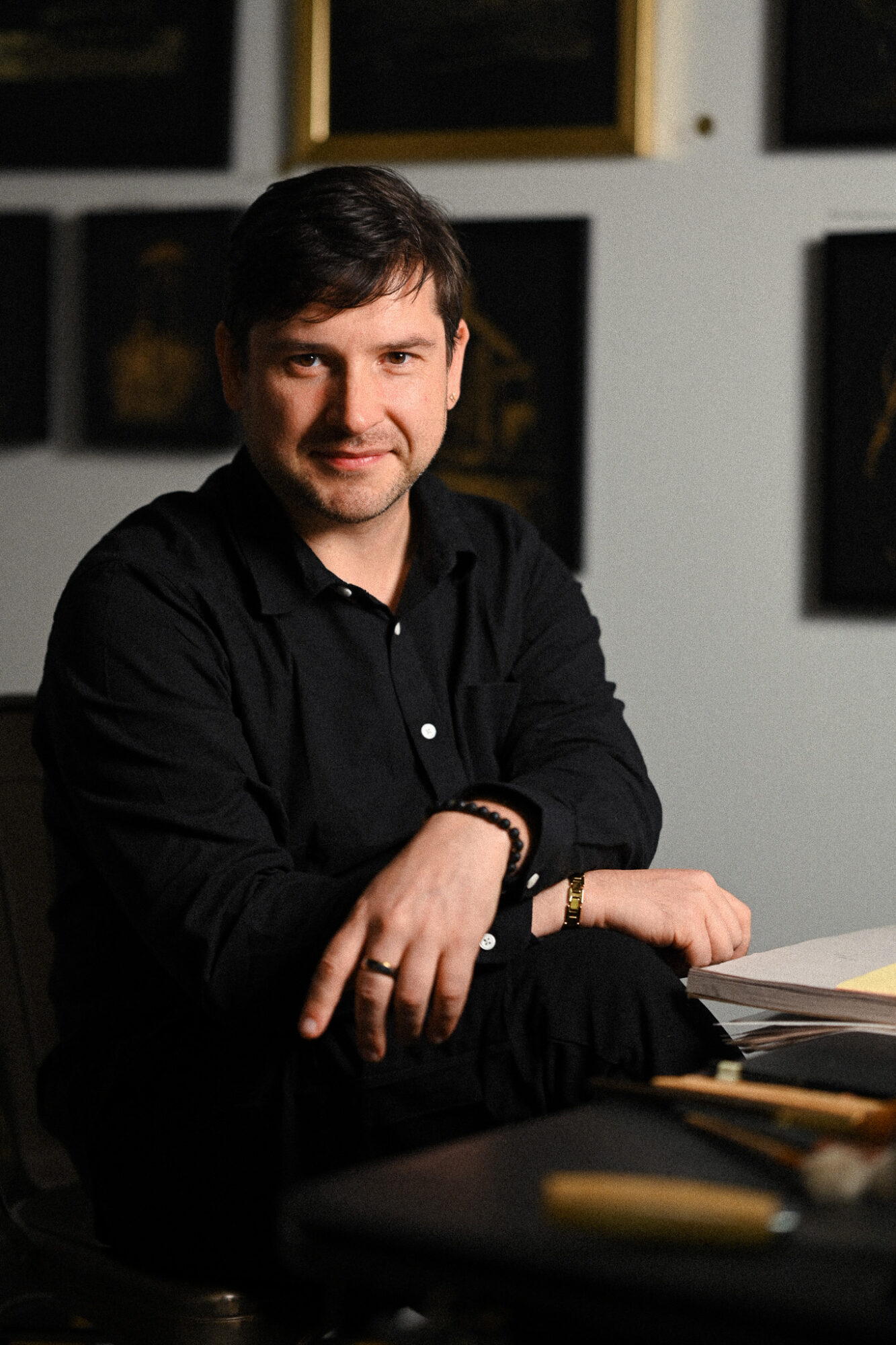
Today we’d like to introduce you to Victor Selin.
Hi Victor, please kick things off for us with an introduction to yourself and your story.
I came to Texas as a scientist, after finishing my PhD in Materials Science at Texas A&M. My days were full of polymers, films and test data. I worked in R&D at Alcon in Fort Worth, developing products for dry eye treatment. To understand how tears move across the eye, I kept sketching eyeballs and eyelashes in my lab notebook. The pages slowly filled with diagrams that started to look more like a strange alphabet than a technical drawing. At home I pushed that further, inventing a personal script and practicing it at night. Much later I realized that this “side exercise” had quietly turned into my main visual language.
Music helped shape the style. I played Irish flute at pubs around North Texas, in Arlington, Denton, McKinney, Granbury and downtown Dallas. Sessions in those rooms trained my ear for rhythm and repetition, and the same ideas slipped into the script on the page. Over time I built a very narrow visual vocabulary for myself: black ground, gold script, a personal alphabet that sits somewhere between hieroglyphs and music notation. Friends in the North Dallas art community invited me to show small pieces at local events. One opportunity led to another, and eventually my work was accepted into juried shows, including the Fresh Ideas exhibition at the Lewisville Grand Theater, where my piece “Fermata Sospesa” hung in the main gallery. That experience made it clear that this was not a hobby any more, it was a second career growing beside the first one.
The journey never felt instant. Gold on black is beautiful and very unforgiving. Many ideas that seemed brilliant in my head turned into failure the moment they hit a real surface. I had to think like a scientist and an artist at the same time. Plan experiments, test on small swatches, write everything down, then scale up only when the result looked strong and behaved well. That discipline lets me promise collectors and curators that the work is not only emotional but also technically solid.
Today I work under the name NoirGold.art as a Texas based gold calligraphy artist and materials scientist. I create originals, limited editions and commissions for real spaces, from quiet meditation corners and children’s rooms to bold gold themed home bars and larger public areas. The Dallas Fort Worth community played a huge role in this path, from the first musicians who let me join a session to the artists and organizers who trusted my early pieces. Science taught me how to test, North Texas gave me a community that believed in the results, and gold on black became the visual language that ties it all together.
We all face challenges, but looking back would you describe it as a relatively smooth road?
It has definitely not been a smooth road. Gold on black is beautiful, but it is not kind.
In the beginning almost every “brilliant” idea I had turned to failure as soon as it hit a real surface. Glue dried too fast or too slow, the gold grabbed in the wrong place, a small fingerprint or dust speck ruined hours of work. When you work with real gold on deep black, there is no Ctrl+Z. One stroke is forever. That creates a constant fear of mistakes. I had to learn to move that fear into tiny tests, not into the final piece. The rule became: suffer on a small swatch, not on a finished board. Plan the experiment during the commute, try it in the evening, write down what happened, and only then trust it for a larger work.
The second challenge was energy and time. For years I was working full time in materials science and building the art quietly next to it. That meant late nights, weekend framing, and carrying panels to shows after long days of lab work. Applications to juried exhibitions sometimes landed as rejections, shipping costs hurt, and there is nothing glamorous about packing a fragile gold piece for a road trip across DFW and worrying the whole way. I also discovered that “being an artist” secretly includes being a carpenter, accountant, driver and customer service all together.
The third obstacle is the mental balance. Gold and black invite perfectionism. My head always wants one more adjustment, a cleaner edge, a better gloss transition. At the same time there is a business reality: orders, deadlines, prices, rent. I had to learn to stop before I destroy the life in a piece, to accept that some ideas belong in the sketch pile, and to ask for help. Friends stepped in with promotion ideas, honest critique, even baking experiments like tiramisu for open studio events, so visitors experienced the work in a warm, human way instead of a cold white cube.
So no, it was not smooth. It has been a long sequence of small failures, corrections, and tiny victories. The good part is that every struggle translated into a habit: test small, protect energy, keep the work human. That is how the road became walkable.
Thanks for sharing that. So, maybe next you can tell us a bit more about your work?
I work under the name NoirGold.art and I specialize in gold calligraphy on deep black surfaces, using a personal script. From a distance my pieces read as clean, graphic silhouettes. As you come closer, you start to see that everything is built from tiny strokes, glyphs and shifts in gloss that catch the light differently. People often describe it as a mix of hieroglyphs and musical notation, which makes sense to me, because the work grew out of both science and music.
What sets me apart is that the surfaces are engineered, not improvised. I have a PhD in Materials Science from Texas A&M and I spent years in R&D at Alcon in Fort Worth, working on products for dry eye treatment. That mindset never left. I do peel tests, drying tests, and burnish tests on small swatches before I trust any method on a final piece. I plan experiments in my head on the way to work, run them in the evening and write down every result. The goal is simple: if you hang a piece in a meditation room, a child’s bedroom or a gold themed home bar, you should feel the emotion and also trust that the surface will hold up.
I am proud that my work already lives in very different kinds of spaces. One client chose a calm piece for a small meditation room. Another picked a glowing, almost playful script for a child’s room. Someone else built an entire home bar around a gold and black centerpiece. North Texas exhibitions have been important milestones too. Seeing my piece “Fermata Sospesa” hanging in the main gallery at the Lewisville Grand Theater during Fresh Ideas was a clear moment of “this belongs here.” It confirmed that a narrow language, gold on black with a personal script, can carry both intimacy and presence in a serious gallery.
In short, I create a focused type of work: gold on black, strict in materials, rich in detail, meant to shape how a room feels. I am most proud that this language, born from lab notes and Irish pub sessions, now functions as a real option for people who want their space to feel calm, sophisticated and a little mysterious.
What makes you happy?
What makes me happy is when all the pieces of my strange little world line up, community, science, music and gold on black.
I am happiest in a room full of people who care about something. Irish session nights with friends, trading tunes and jokes. Conversations with other artists about surfaces and light. Science colleagues who can get excited about a good experiment. It all feels like the same energy, curious people testing ideas in real time.
In the studio, happiness is that quiet moment when a piece finally looks the way it did in my head. Gold and black are not forgiving, so there are many evenings of “almost.” When it clicks, when the rhythm of the script sits right and the light behaves, it feels like solving a puzzle that nobody else could see.
The other big part is connection with collectors. The best feeling is watching someone’s face go from polite interest to “wow, this is stunning.” One woman bought a piece because her husband was a conductor, like my father. The work had a musical, suspended feeling, and she saw him in it immediately. Moments like that remind me that art is not decoration, it is a conversation between two lives. I keep it personal. I follow many of my clients on Instagram, I see my pieces in their homes, and they show up in my comments and stories. They support me, I cheer for them. That ongoing loop of making, sharing and staying in touch is what makes this whole path feel not only beautiful but also very human.
Pricing:
- Small 8×10 archival gold-on-black edition prints (unframed) generally start around $120
- Mid-size 18×24 original gold calligraphy works typically range from $700–1,200 (unframed), depending on detail
- Large originals 32×40 and above in genuine gold leaf on museum-prepared surfaces with custom framing are usually around $5,000
- Site-specific commissions for homes, offices or bars generally begin around $2,500, with final pricing based on size and complexity
Contact Info:
- Website: https://noirgold.art
- Instagram: https://www.instagram.com/noirgold.art/
- Other: https://www.etsy.com/shop/NoirGoldART
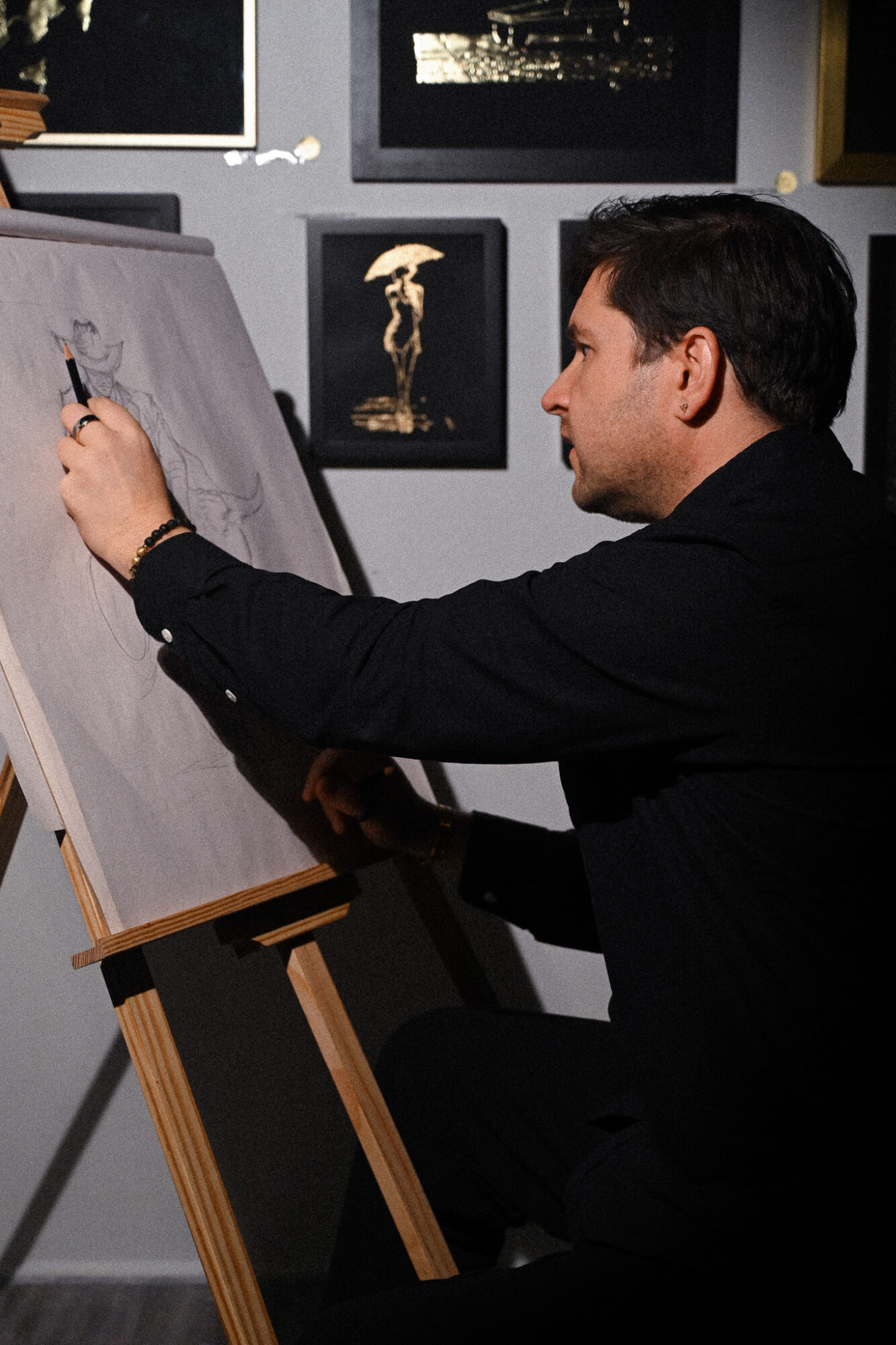
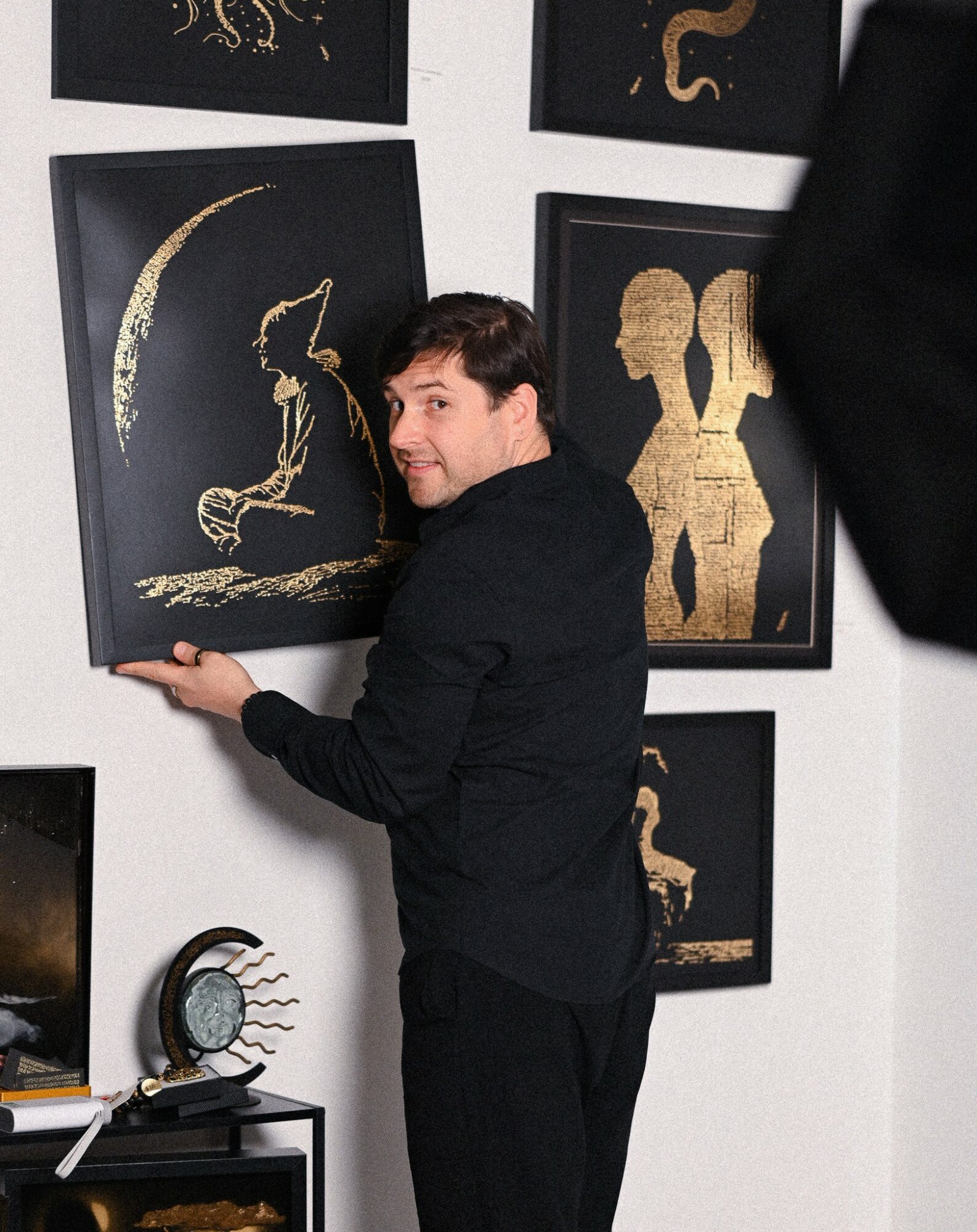
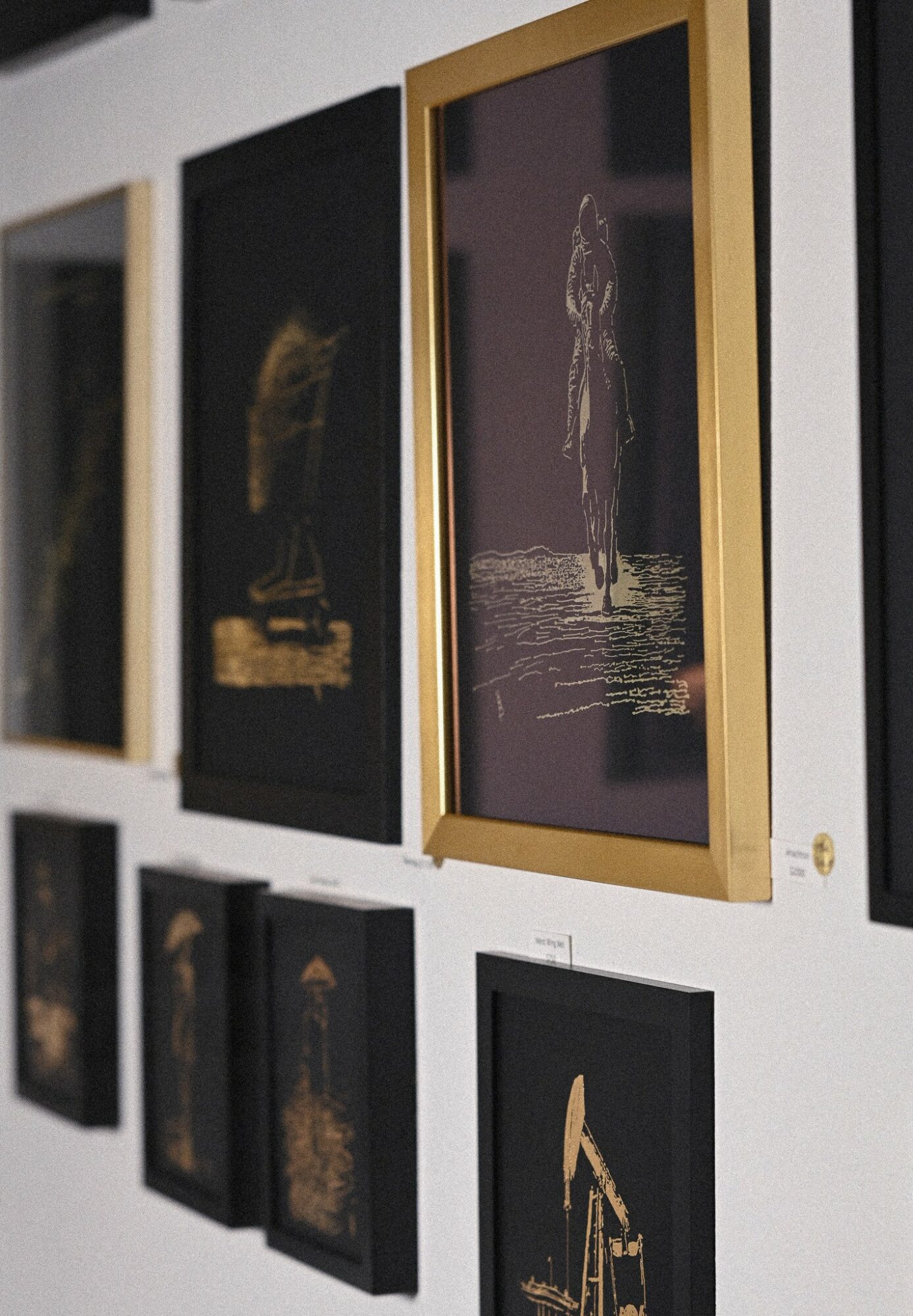
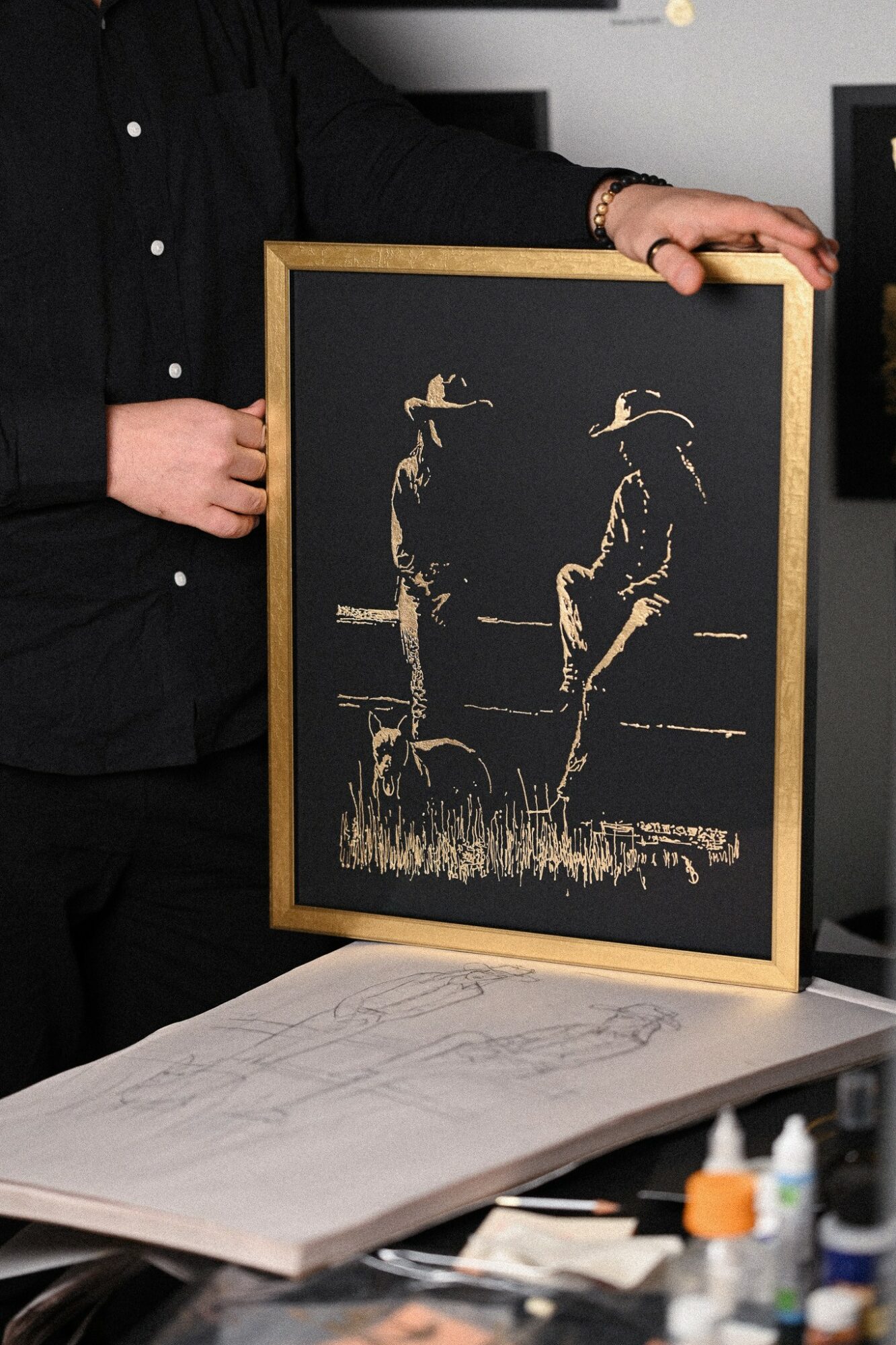
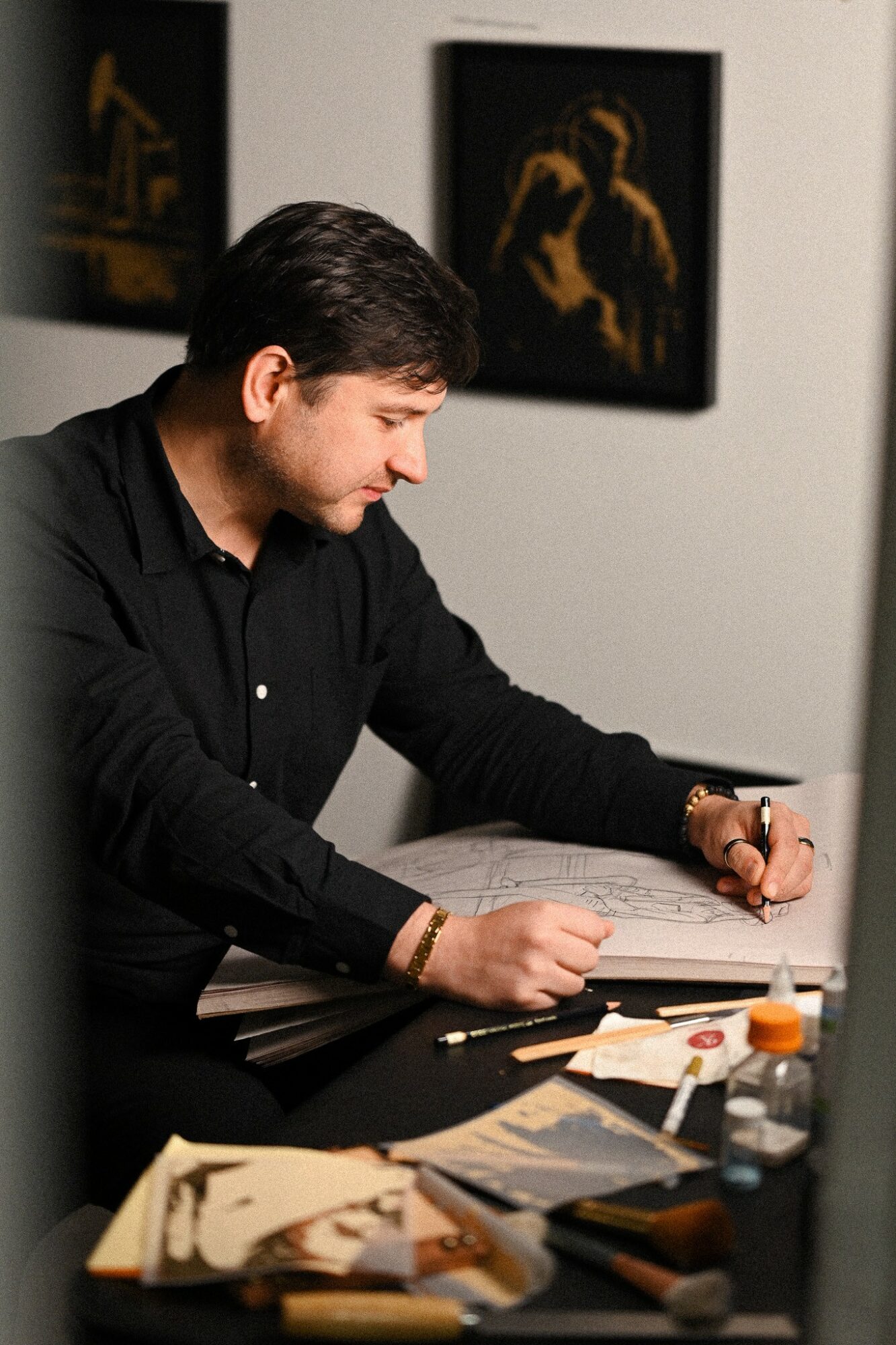
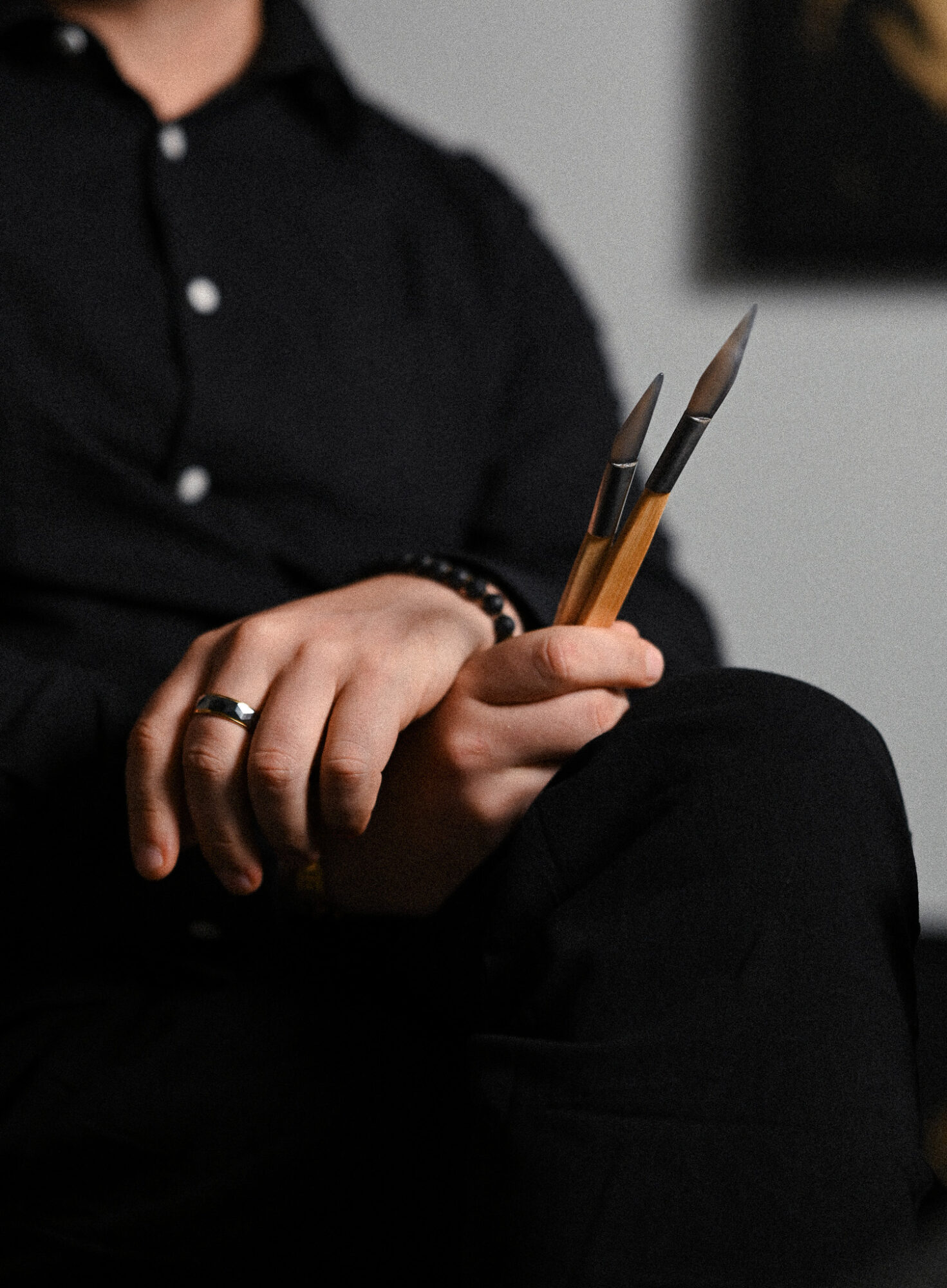
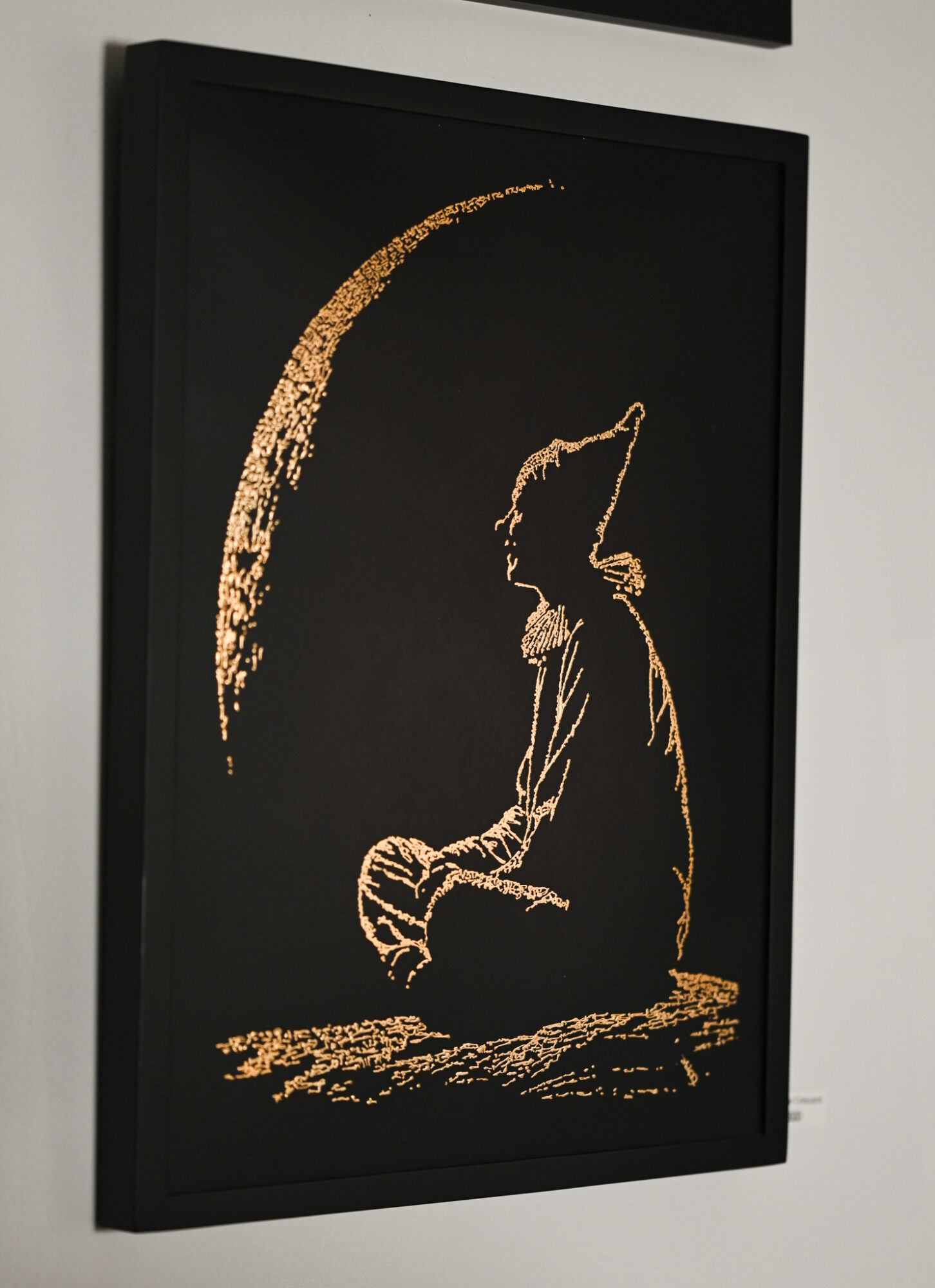
Image Credits
Anastasiya Ilinskaya