




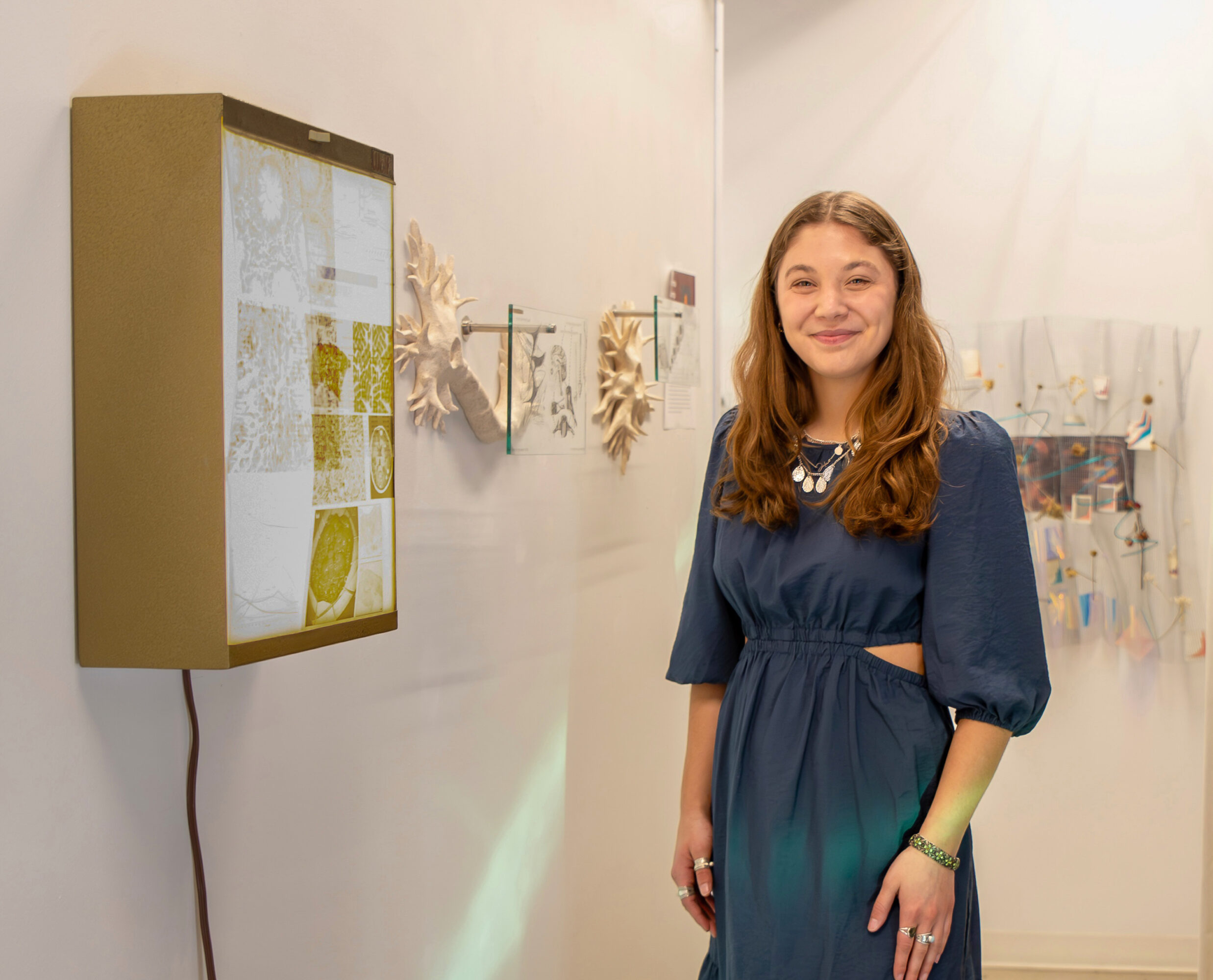
Today we’d like to introduce you to Emma Camp.
Alright, so thank you so much for sharing your story and insight with our readers. To kick things off, can you tell us a bit about how you got started?
I am intrigued by science yet conversely, overtly philosophical, with an ardent passion for art and art-making. In high school, my favorite courses were science, in particular biology, and art, where I created my first 2- and 3-dimensional bodies of work in my Advanced Placement (AP) art courses. Still to this day, my tendency to ponder questions rooted in scientific and philosophical uncertainty fuels my creative and academic pursuits. This wondering and questioning inspired me to pursue a behavioral neuroscience degree in the hope of understanding, at least scientifically, the complexities of the brain, and how differing perceptions alter how one understands the world. Through my undergraduate education at Lehigh University (Bethlehem, PA), I was given the knowledge of how our brain takes in sensory information and filters out “deemed” unnecessary inputs, consolidating and preserving that of significance. I feel as though I have a deep scientific understanding of and curiosity for how people’s minds are shaped and continuously evolve, ultimately influencing how they understand themselves and navigate their environment. Art and science are usually thought of as two separate and distinct disciplines. It has always been my perspective that well-researched science is an art form and conversely, much of art is innately scientific, with art being both spontaneous and emotional as well as logical and intellectual.
My first taste of scientific art was through my involvement with a research program at Lehigh University called NeuroSalon, the brainchild of Dr. Julie Miwa (Associate Professor, Neuroscience, Lehigh University), which is a group of scientists and artists communicating the link between neuroplasticity and creativity. Being the student project lead, as well as lead artist, I was able to create and exhibit curated pieces showcasing complex neuroscience concepts and research in a visual medium, some of which became included in my applicant portfolio to graduate school. Based on my work with the NeuroSalon project, I was appointed a fellowship to Lehigh’s Creative Inquiry program. Additionally through the mentorship of Professor Deirdre Murphy (Assistant Teaching Professor of Art, Lehigh University, https://www.deirdremurphyart.com), I was selected for an internship with Chimaera Gallery (Philadelphia, PA; https://www.chimaeragallery.com), Philadelphia’s premier art, biology, and technology gallery. Working closely with the gallery director, Angela McQuillan (https://angelamcquillan.com), I learned about gallery management, social media marketing, and most importantly, participating in the integration of art and science within the public sphere. I also had the amazing opportunity to serve as Studio Assistant for Rebecca Rutstein (https://rebeccarutstein.com/), a Philadelphia-based environmental artist who sheds light on hidden networks in nature to foster deeper connection and environmental stewardship. I was able to witness and assist in her professional practice, continuing to fuel my resolve to foster interdisciplinary collaborations (science and art), utilizing different skill sets and ways of looking at the world in order to create the critical connections necessary connecting the viewer to an idea. I am also incredibly lucky to have had many people who have inspired me and helped shape me as an artist. And specifically, to have been mentored by phenomenal female artists, both at Lehigh University and in the Philadelphia science-art community, who taught me to trust my instincts, be curious and questioning, and most of all, to keep creating.
Now as a third year Masters of Fine Art student at Texas Woman’s University, I create artwork at the intersection of science and art, taking observations, enhanced by art, to help promote a deeper learning and understanding of complex scientific concepts. My artworks tend to exemplify concepts ranging from neuroscientific cellular interactions and signaling to the broader implications of biological research and its applications. At Texas Woman’s University, under the leadership of Colby Parsons (Division of Visual Arts Chair, Professor of Ceramics & Digital Craft; https://colby-parsons.squarespace.com/), I am incredibly lucky to be mentored additionally by Tanya Synar (Associate Professor of Sculpture; https://tanya-synar.squarespace.com/), Giovani Valderas (Assistant Professor of Drawing and Painting; https://www.giovannivalderas.com/), and Sheli Petersen (Associate Professor of Art; https://spetersenillustration.com/index.html). Being surrounded by passionate and talented educators and peers has been the most rewarding part of my academic journey to date. I have also had the opportunity to give back to this community, serving as an undergraduate course instructor, allowing me the platform to share my knowledge and love for the arts while serving as a mentor for the next generation.
Would you say it’s been a smooth road, and if not what are some of the biggest challenges you’ve faced along the way?
As with anything in life that matters, challenges and struggles promote learning, teaching one adaptability and resilience. And with art, this can relate to the creative process as well as the materials themselves. Oftentimes, one needs to let an idea sit for a while before one sees the true potential, and for me this can be frustrating. But I have learned over the years that there usually is a payoff (at least personally) for letting an idea marinate instead of rushing it to fruition. Even as art is created, there is a process (sometimes a long one) of trial and error. Recently, I was working fusing (firing in a kiln) decals to glass and it took numerous attempts to detail the correct firing schedule (temperature and time). Luckily, it all worked out, and I’m extremely proud of the final product, but it was very trying at the time. Another struggle I have had to face is navigating some of the pitfalls of being a showing artist, such as artworks that I have spent numerous hours making being damaged at gallery installations, and even one of my artworks being taken off a wall in a public gallery setting, for which it was never recovered. While it is easy to be disappointed and discouraged when unfortunate occurrences happen, I try to remember that these are just some of the nuances of the art world.
Thanks for sharing that. So, maybe next you can tell us a bit more about your work?
I am fascinated by the intricate systems of science, more specifically neuroscience, that shape our biological and perceptual worlds. Much of this complexity exists beyond the visible – hidden within microscopic patterns and neural networks that quietly sustain life. Through painting, sculpture, ceramics, metalwork, and installation, I translate these invisible processes into tangible visual forms that bridge art and science. Drawing from my unique background in neuroscience and experience within research environments, I explore the balance between discovery and uncertainty. Using biomorphic abstraction, tactile materials, and repurposed scientific imagery, my work reflects the beauty, tension, and ethics of scientific inquiry while distinctly inviting viewers to encounter the unseen connections that compose and surround us.
One of my recent bodies of work was developed in conjunction with an independent study with the Saelices Lab at the University of Texas Southwestern (Dallas, TX), where I have been participating in Alzheimer’s research and developing visual art inspired by scientific data and observation. This collaboration, under the direct leadership of Lorena Saelices Gomez, PhD, has allowed me to work directly with cutting-edge research and researchers, learning the procedures they use within their inquiry, and translating data and molecular imagery into visual narratives that seeks to bridge the gap between scientific understanding and public skepticism or apathy toward the importance of scientific research. I amplify visual experiences of the scientific research environment and provide a glimpse into the present climate of Alzheimer’s research and the collaborative, diligent professionals dedicated to isolating the cure. My work reveals the profound significance and the inherent paradox of such research. While early diagnosis holds the potential to greatly improve quality of life, the absence of a definitive cause and cure raises critical questions about the broader purpose and implications of these advancements. I seek to communicate these complex questions to a wider audience, highlighting not only the ethical and conceptual dimensions of scientific inquiry, but also the visual and aesthetic beauty inherent to the research itself.
Do you have any memories from childhood that you can share with us?
Long before I considered a science art career path, I visited the Georgia Museum of Art. The artworks in collection captivated me, but one piece in particular drew me in, Shimmer by Rebecca Rutstein. This large steel structure containing hexagonal shapes and LED lights was the first true intersection of science and visual art I had been exposed to and I was fascinated by it. Fast forward several years, I attended a lecture by Lehigh University’s Department of Art, Architecture and Design, where a guest lecture was being given by Rebecca Rutstein – THE woman whose work inspired me so many years prior. This lecture changed the entire trajectory of my studies. Instead of pursuing a doctorate in neuroscience with the path of laboratory scientist in my future (although I’m not ruling it out as part of my 10-year plan), I, then and there, decided I wanted to do what Rebecca Rutstein did – scientific art. Full circle moment – was privileged to serve as her studio assistant years later.
Pricing:
- Inhibitory – $750
- Slides Study – $200
- Synaptic Scaffold – $850
- Anaxonic – $500
- Iron Age of Science – $1750
Contact Info:
- Website: https://emmacamp.com/
- Instagram: https://www.instagram.com/emmacampstudio/
- LinkedIn: https://www.linkedin.com/in/emma-camp-487286245
- Other: emmacampstudio@gmail.com