





Today we’d like to introduce you to Alan Brunton.
Alan, can you briefly walk us through your story – how you started and how you got to where you are today.
At the age of 5, I started singing in Amarillo, TX. Born in Dallas, but raised in Amarillo, my high school years were an awakening of sorts to the pull of music. I was a Texas All State Choir Member for two years and decided to spread my wings further, going off to college to study applied vocal music. My father was an inventor. He was such an out of the box thinker, using technology of Nicola Tesla that the FDA shut him down twice for his developments, undercutting a major chemical manufacturer by 92% and Big Pharma by 85%. Music was a magnet, pulling me to it. After studying opera at the University of Oklahoma, I moved to Dallas to get my feet wet in professional opera, singing with The Dallas Opera for 8 seasons.
Back then, the employment for the opera chorus was only 4 months out of the year, so I needed to work in the restaurant business. I would say that my highest achievement there was getting to be captain/ assistant maître d’ at the French Room, at the Adolphus Hotel. We were rated in 1982 as the 3rd finest restaurant in the country. Going in 2 hours before my shift each day to learn from the chefs their techniques and history of French cuisine, it gave me an edge over the seasoned FOH workers quickly. I ended up setting sales records there and expanded my business savviness of the industry and shifted to Marty’s Gourmet on Oak Lawn. Several people remembered me from The French Room and asked me to open restaurants for them. I ended up opening 33 different places, a few of my own.
When did you have time to continue to sing?
In 1992, I was back in music, working on a Master’s degree in Washington, DC at Catholic University of America, when I got invited to sing at The Vatican. I became disenchanted with the performance of opera due to administrative policies and then moved back to Dallas in 1994.
Understanding business was now my goal and was offered a position as administrator for a startup company, Claimsnet.com. Growing from 28 employees to over 130 in less than a year and taking the company public (NASDAQ), raising $42 million, buying two other companies, I was trained in Investor Relations. Being a desk jockey was not my cup of tea. I went back to music. There was that pull again, something that drew from my soul. I spent 6 years singing as a “highered gun” for Preston Hollow Presbyterian Church. Working with the choir as a soloist/section leader, we grew the choir from 53 to 130, from 3 tenors to 22. Getting married took my wife and me away from Dallas, to open a B&B with a 4 Star restaurant.
In 2009 I moved to Florida and helped a friend open two restaurants. I began looking into areas with unanswered questions of religion and science, which lead me to seeing people using complementary and alternative healthcare, more specifically, sound healing. I thought it was good to see people using natural applications of sound to get relief from stress, inflamed muscles and tendons. I looked closely into the specific frequencies that these sound healers were using and saw that they were all using the exact specific frequencies. I thought this to be thought provoking but knew that I couldn’t tell my friends about this, that they may say “Come on Alan. That’s a bunch of Woo Woo.” So, I started digging deep into Western Medicine research (Johns Hopkins, Mayo Clinic, Harvard School of Medicine, MIT and the Oxford Neurological Institute). For years I researched how they were publishing clinical trials on how they had applied specific frequencies to their test subjects and shown a raised cognitive ability. They were also defining white noise as being detrimental to cognition, while it also induced stress in the central nervous system and produced a reduction of essential chemicals in the body, such as dopamine. The light bulb turned on. I asked “If all of these frequencies are in all digital audio, WHY DOESN’T SOMEBODY DEVELOP SOFTWARE THAT WILL ANALYZE A DIGITAL AUDIO FILE, LOCATE THOSE GOOD FREQUENCIES AND FILTER THE WHITE NOISE, SO WITHOUT CHANGING THE QUALITY OF THE RECORDING, THE LISTENER WILL HAVE MORE ENERGY, LESS STRESS AND A HIGHER COGNITIVE FOCUS?” I was told “That’s never been done before.” I immediately said “OK. I’ll do it.” And Cymatrax was born.
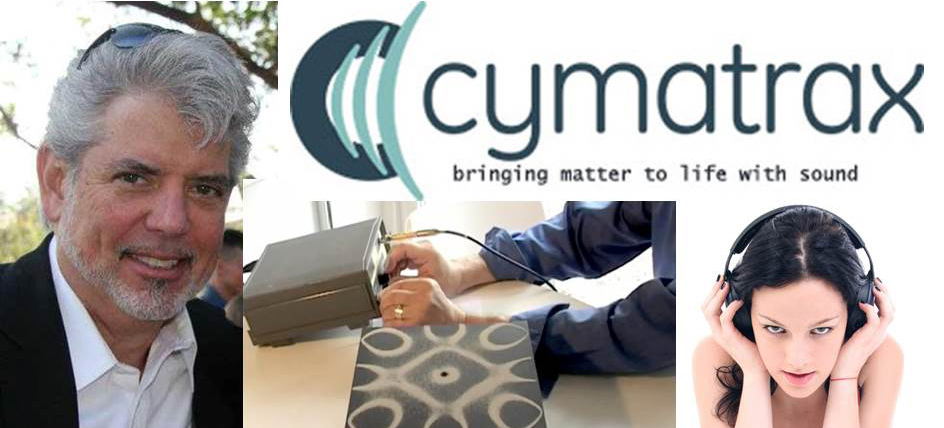
“Cyma” is an abbreviation from the word Cymatics, the observation of how sound moves matter. “Trax” is a shortened version of tracks of music. You have seen videos where a stereo speaker is on its back and a metal plate is put on top. The fine sand is placed on that plate. An amplifier is turned on and then a frequency generator. If you look closely at the horizon of that metal plate, you see the sand is bouncing up and down. Modulate the frequency and the sand forms a geometric pattern. This is an example of how specific frequencies move efficiently through the central nervous system, communicating with the brain and how the others (white noise) disburses their energy inefficiently through the cellular structure.
I was taken to Austin, TX and introduced to two men, the Founder/CEO of MagRabbit and the chief software buyer at Dell. When I presented to them about my software concept, they both gave it a green light for production. The response from Dell was “Once launched, this software will go global in less than one year. Had you come from software, you would not have thought of this. The problem is the same. Since you don’t come from technology, it will take you longer to get this to market. I wish we could partner with you, but I can guarantee that there is not a single person at Dell that has the skill set to write your code. Good luck.”
Many people have suggested moving to either Silicon Valley or Boston, where people will see the huge future in this. But I am a proud Texan. I want to help expand business in Dallas and believe that tech and healthcare will come here.
Overall, has it been relatively smooth? If not, what were some of the struggles along the way?
Finding someone to write the code for the acoustic based software was a challenge. Only one in 1000 had such a skill set. I worked with SMU defining what was needed. After looking at over 1200 resumes, there was one man, a fellow musician, who had the needed skill set.
Two years ago, the software was completed and we began the patenting process. A good friend of mine recommended someone from his firm and it was a perfect fit. Now patent pending, and seeing no other applications ever in this field, we feel very confident to receive the patent shortly.
Not being from the tech world, I started by getting involved with as many groups as possible, to ask for advice. I joined the Dallas Entrepreneur Center and visited with multiple mentors. Part of their partnership was with The Capitol Factory in Austin who was expanding to Dallas. I also met with their mentors and even flew out to Silicon Valley to pitch my software to a Venture Capitalist Summit. Talk about a learning curve! VCs were no longer Venture Capitalists. They worked on investing into fields where there was already a market. They were looking for a Burger King concept to compete with McDonalds. Even meeting with a mentor from Austin who sits on three different boards of directors in healthcare, I was told “I LOVE IT! Sign me up! I will use your software, but I can’t take you into the board to raise operating capitol, because you don’t have a track record. We have to see user acceptance before we can fund a project.” With this being said, we decided to launch our software, Version 1, as a free app to the android market.
Cymatrax – what should we know? What do you guys do best? What sets you apart from the competition?
As Founder/CEO, I have met with two neurologists at University of Texas Southwest. Both said all of the clinical trial data I presented to them was “logical’ and they are interested in doing our clinical trials, as they see the future of this application used as a daily therapy for autism. Other neuroscientists have agreed, saying “Then after that, it would be logical to go after dementia, Parkinson’s Alzheimer’s, ADHD, PTSD.” This will benefit millions.
I met an executive at Deloitte and who is interested in possibly licensing our technology for corporate training. “Only 8-10% of people using AV training are engaged in the training. 90% are disengaged. We are looking for ways to connect the training and retention. Call us when you are ready.” This told me that ALL digital audio could use this technology (podcasts, books on audio, corporate training, online education).
With two separate law firms doing patent searches for our technology, nothing comes close to what we have now submitted to the USPTO.
So, what’s next? Any big plans?
For the B to C market, Versions 2 and 3 will subscription based and will come out shortly after our launch, which is planned for mid-August, 2018. And again, once funding comes, we can add more employees to control other distribution of verticals.
As soon as we launch the free app, all we need is 2000 downloads before the analytical red flags go off to all of the big boy companies, i.e.; Apple, Google, YouTube, healthcare systems, etc. Version one of the app will only be for Android users, our funding is tight now. We expect IOS users to demand a version for them as well. The Android user market is higher in percentage in the EU, where they are also more open to complementary and alternative healthcare. We expect a huge download from them, as well of the current information subscribers in the US market.
As soon as we show income (if not sooner), we plan to form a 501.c3 to further R&D into healthcare. Our research shows a huge bell curve ramping up in music therapy and sound applications. One company, NOVOCURE, raised $95M from T. Rowe Price and then another $164M from an IPO to cure a type of brain cancer using sound waves. They also have FDA approval to use this technology.
As Version 3 of our software is launched and we get just 1% of the Spotify market ALONE, it will generate over $400k monthly revenue.
With over 1500 commitments from Facebook and LinkedIn, we are daily receiving requests for more information and for notifications of when we will launch. I know that it will help many and am just hoping that our servers won’t blow up with so many requests. The magic number in the app download market is 2000. Once we hit that mark, red flags go off in all of the data analytics in large companies and they will ask “Who are you? How did you do this?
We are currently engaged with more help from SMU MBA students to become a part of this world changing breakthrough. I have now committed my work and life to bring this to the world. Dallas is now a focal point in this game changing awareness of how sound changes our daily lives and how we now can make all sound applications better for better health.
Pricing:
- Version 1, will be available for 25ok free downloads
- Version 2 will give the user the ability to increase an amount of white noise filtering, which will greatly help in spoken word audio, ie; podcasts, books on audio, corporate training, online education, and here we will have a monthly subscription rate of $1.99.
- Version 3 will be for streaming media and we will charge around $3.99 per month subscription.
Contact Info:
- Website: www.cymatrax.com
- Phone: 214-923-9463
- Email: info@cymatrax.com
- Facebook: https://www.facebook.com/cymatrax/


Getting in touch: VoyageDallas is built on recommendations from the community; it’s how we uncover hidden gems, so if you know someone who deserves recognition please let us know here.