






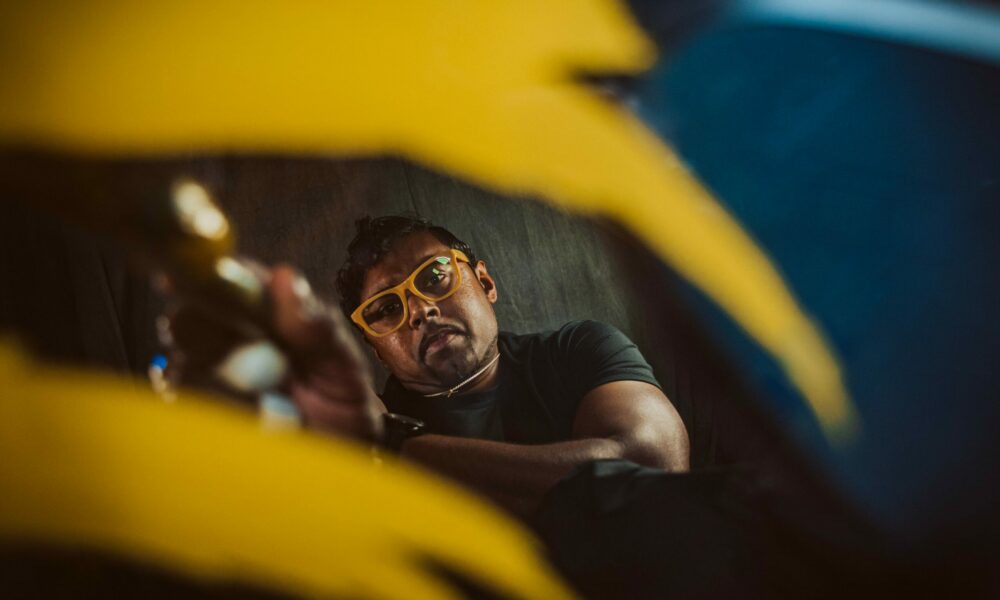
Today we’d like to introduce you to DJ Perera.
Hi DJ, it’s an honor to have you on the platform. Thanks for taking the time to share your story with us – to start maybe you can share some of your backstories with our readers.
Being a practicing artist isn’t an uncommon phenomenon. Ever since the Abstract Expressionist era, America and American artists have cemented their spot in the global art community. What is unique is that my story, which is the essentially the story of my creativity, begins in the conservative Middle- Eastern State of Qatar where I was born, raised, and educated. Growing up as an Asian and living in the Middle East and South Asia, art is not a career practice that is encouraged nor were there any industries or institutions that promoted it. However, being educated in a private British school, I was able to pursue art and design for my board exams thanks to the availability of top-class European educators and of course my parents’ broad-mindedness. I have repeatedly stated how, as Asian parents, my Ammi (Mother) and Thathi (Father) took an enormous financial and cultural risk in supporting my artistic pursuits academically- especially when I was only seeking to apply to fine arts programmes in Australia, New Zealand, and America. My journey to America began with a relatively new search engine back in 2005. A primitive Google search for, “top ten art schools in America” generated an extensive list that was alphabetically organised. Texas Christian University grasped our attention. Thanks to a dear friend who helped me procure the admission application, TCU was the only university that I applied to and got accepted. I became a freshman at the age of 17 and the rest is history.
At the age of 21, I had two solo exhibitions thanks to Arts Fort Worth and the Dallas-based Ro2Art gallery. I graduated with my MFA degree from Pratt Institute at the age of 23 and instead of pursuing a university teaching profession, I worked as a National Advisor for the Permanent Mission of Sri Lanka to the United Nations where I was privileged enough to work amongst UN Ambassadors and hear and see power manifest itself through iconically famous and infamous world leaders at the General Assembly and the Security Council. I returned to Fort Worth and had the great fortune of working for the Modern Art Museum of Fort Worth where I served as an Information Associate. My destiny to teach began at the age of 24 where I served as an adjunct instructor at the Tarrant County Community College Northwest campus. The pride and integrity that I felt as an educator at that point reminded me how invaluable and vital my educators were when I was in secondary school. Beginning my education career at the collegiate level naturally instilled an excessive level of expectations that I mold my secondary students with. However, my style and philosophy of teaching stems from a cultural experience were growing up and receiving an education within a developing economy, you immediately realize that you need to study twice as hard with twice as little academic resources in order to compete, not with your peers, but with the world. In non-developed countries, education is a privilege and a currency of success.
This mindset is an uncompromising bedrock of how I approach, instruct, discipline, and inspire my students to think creatively, respectfully, and practically. It is how I choose to educate the next generation of students. It is also this same mindset that has allowed me to balance and continuously sustain my studio practice as a professional artist and stay relevant within an ever-evolving and diverse art community in America.
This is one half of my success story. The other half pivots around selfless people who have assisted and elevated me to where I am today. From professors to art dealers to Ambassadors; from Deans to Directors, majority of these people are women and at the top of this matriarchy is my strongest and relentlessly critical advocate. My Ammi.
Can you talk to us a bit about the challenges and lessons you’ve learned along the way? Looking back would you say it’s been easy or smooth in retrospect?
Success never occurs without failures. Success is a by-product of struggles and challenges. I am grateful for the strict level of parenting and the quality of education I received growing up. It equipped me to ground myself, for the most part, when I arrived in America. The main obstacle was transportation. I soon realized that one cannot survive in Texas without a car. As a Sri Lankan, handshakes and smiles were my only bargaining tools. Thankfully, TCU was one giant friendly bubble. In this bubble there were a myriad of Americans that transported me to buy art supplies, install my exhibitions, transport me to and fro from the airport, and even let me sojourn with them when I had nowhere to stay during the TCU seasonal holidays; from Glen Rose to Houston. In this giant purple bubble, camaraderie was abundant and provided the support system that I did not realize I needed to successfully pursue my studio practice with discipline and fidelity.
Outside of this bubble exists challenges that no educational institution or curriculum can you prepare you for. Marriage and mortgages are the most critical. Finding the balance to perform your husbandly duties and meet your financial responsibilities without compromising your studio practice is not easy. This was compounded by the fact that I was also a foreign immigrant on an F1-visa. Fulfilling all the USCIS regulations and stipulations set forth by the Department of Homeland Security just to maintain legal immigration status post-graduate school was a hindrance. I remember a two-month period in 2013 when I was unemployed because my work permits expired. No income. No employment. Thankfully, while my In-Laws let me paint in their garage so that I could continue to build my Transcendence series, my Wife was the breadwinner and provided the roof and meals for us…without any fuss. The role she has played in my evolution as an artist cannot be overstated enough. The administrative leaders at the Modern Art Museum of Fort Worth were aware of my predicament and when my immigration status was restored, they ensured that my part-time position was reserved for me for when I returned. The Modern Art Museum of Fort Worth’s altruism allowed me to continue my livelihood and studio practice undisrupted.
Another significant and recent obstacle was the Covid-19 pandemic of 2020. Due to the global lockdown, access to basic necessities was nil. For an artist, the basics consisted of art supplies. In my case, since there was no access to canvases, paints, and other related mediums, Consequently I decided to completely change my oeuvre. In fact, during my panel discussion for the 2020 “State of the Arts” series hosted by the NPR KERA and the Kimbell Art Museum, I remarked how the pandemic was a blessing for me. The unprecedented economical, domestic, and personal obstructions that the pandemic wrecked upon every facet of society was the right nudge I needed to reinvent myself. I consciously switched to the time-consuming technique of pointillism…since there was ample time why not. My current body of work revolves around a series of 19 hyper-realistic pointillism drawings that revolve around my Sri Lankan heritage. The series is halfway complete and yet it has already garnered a lot of positive attention and acclaim. I am proud to say that the recognition and awards are equally diverse; from the Sasha and Edward. P. Bass “New Normal” grand-finalist grant, to the 8th Annual Tarrant County Black Historical and Genealogical Society juried exhibition. I feel compelled to add that the pandemic paradoxically offered time to finesse my roles as a Husband and a father. Family time is precious time.
As an art educator, however, the pandemic did paralyze, if not crippled, our ability to execute and provide quality instructional learning to our students. The sudden and dramatic switch to remote learning was incredibly taxing and presented an unwelcomed conundrum for both students and educators; the uncomfortable coalescence between professional and residential spaces. For me personally, what was incredibly frustrating and truly challenging was the ineffectiveness to teach abstract and conceptual techniques without being able to demonstrate in a traditional manner. This was immensely problematic since I was teaching an AP 2-D Art & Design course. The outcomes that that period yielded in terms of academic instruction and engagement should not be repeated for the sake of educational integrity and for the sake of the student’s education. One aspect that I am grateful for as an educator during that tumultuous time is the fact that our job security, salary, and medical benefits were never compromised. While many other professionals in other industries were not so fortunate, I am grateful for the stability that the school districts protected on behalf of its teaching force. That occupational stability coupled with the American government’s generous stimulus packages, undeniably influenced the fortuitous outcome of my present circumstances.
As you know, we’re big fans of you and your work. For our readers who might not be as familiar what can you tell them about what you do?
Throughout my years of teaching as an educator, the most proudest moments have occurred outside of the classroom- gallery opening receptions. As an art educator, being able to simultaneously exhibit works invariably presents a vital learning experience that cannot be replicated in the classroom. The pride that I get when I invite my own students to my own opening reception and they attend is immeasurable. It is in those instances that you witness inspiration and aspiration engulf a young mind.
Since my undergraduate years, my work has always included elements of my Sri Lankan heritage. It has always been pivotal to stay true to this, especially in an ethnically pluralistic country like America. Preserving my identity and expressing it in a visual medium has always been my focal point. My passion for art, my accolades in art, my degrees in art, my parents’ investments and sacrifices for my art, will always dictate how I educate my students about art and its viability in the community.
Henceforth, I have re-modeled myself to where I am neither just an “artist” nor just an “art educator.” I am an artist and an art educator. My belief is that if I am not sustaining my professional practice, then I cannot truly offer an authentic learning experience that bridges classroom learning with real-world learning. As a result of continued hard and dedicated work, I am blessed to have been a two-time visiting artist for the Kimbell Art Museum’s studio programmes; served as a curator and gallery manager for the Funkytown Festival Gallery; currently serving as a board member for the TCU Friends of the Library; became the first Sri Lankan artist to be included in the TCU Library’s permanent art collection; recently received a grant from the Eagle Mountain Education Foundation that will see Boswell High School students partake in an intensive collegiate studio workshop with the TCU College of Fine Arts, and my next engagement will involve speaking in a panel for the upcoming Startup Champions Network Leadership summit which Fort Worth will be hosting later this year.
Sharing all these achievements with my foundational and advanced art students is key to truly edifying and driving their aspirations to become artists and creatives in their community. When I was teaching in Fort Worth ISD, I was surrounded by many disadvantaged and socio-economically challenged students at Eastern Hills High School which was a Tier-1 secondary campus. Thankfully, my studio practice and exhibitions was at its apex and I was able to constantly expose and connect my students to a multitude of authentic art experiences that pertained to what I was teaching them in class. Since 2021, I have transitioned to Eagle Mountain Saginaw ISD where I currently teach at a 6 A campus and one of the district’s highest-performing secondary schools- Boswell High School. I am surrounded by an abundance of resources that further enhances my strategies to enrich my students’ authentic learning experiences. One of these resources is the Eagle Mountain Education Foundation which exclusively exists to offer educator grants and student scholarships to nurture EMS-ISD students in their academic growth. To date, the foundation has awarded over $1.3 million dollars in student scholarships and grants and supported its educators with over $63,000 in classroom resource grants. In 2021 I submitted a grant proposal to expose Boswell High School students to a rigorous and intensive studio experience through the TCU College of Fine Arts Digital and New Media course taught by Professor Nick Bontrager. I am proud to say that Boswell High School art students will receive the privilege of experiencing how traditional and non-traditional studio art practices can co-exist in spite of their respective dissimilarities. The educational and strategic community partnership this project presents has been overwhelmingly received with unconditional support from prominent stakeholders; from the Boswell Principal to the Foundations’ Director, to the District Superintendent, and even the Dean of the TCU College of Fine Arts. This is what education should look like across all Districts in every State in every community regardless of its poverty or wealth.
Is there any advice you’d like to share with our readers who might just be starting out?
The only advice that I can impart is take refuge in your passions but do not become a refugee in your own complacency. Do not waste time. Always strive to continuously innovate and evolve.
Contact Info:
- Website: www.djperera.com
- Instagram: https://www.instagram.com/djperera22/


Image Credits
Kristina Brown
Isuru Perera
Chilton Tippin