






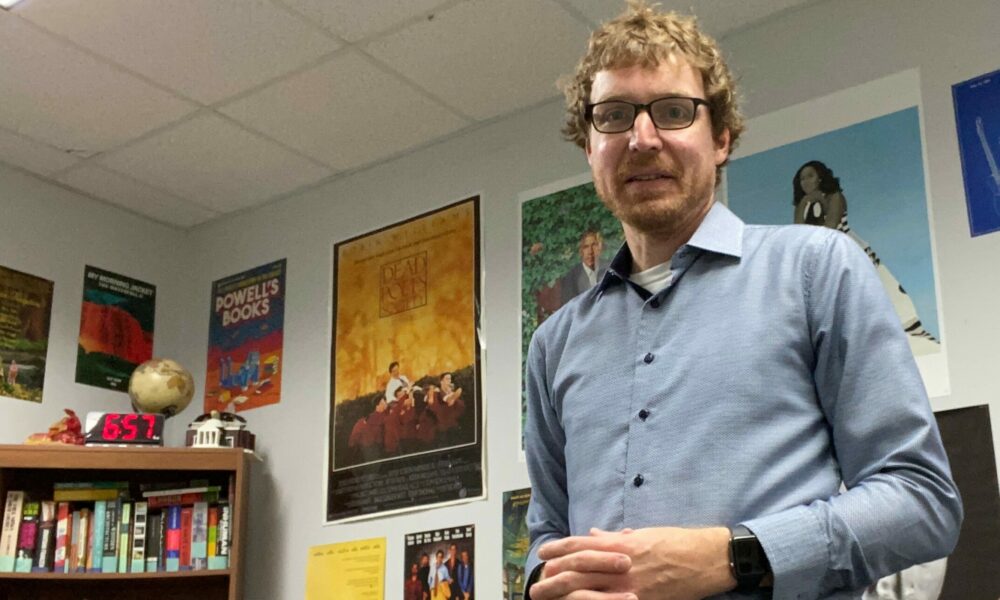
Today we’d like to introduce you to Aaron Sands.
Hi Aaron, it’s an honor to have you on the platform. Thanks for taking the time to share your story with us – to start, maybe you can share some of your backstory with our readers.
I’m 47 years old and just beginning my 26th year as a public-school teacher, all in Plano ISD. I grew up in Grapevine, TX, where my mom was an elementary school music teacher, and my dad was a licensed electrician who eventually worked as the Director of Facility Services for two local school districts. Both of my younger siblings are public school English teachers as well: my brother in Portland, OR, and my sister in Pflugerville, TX. My family has always been active in our local church communities where I had the opportunity in high school and college to lead various small groups and serve in volunteer leadership opportunities. These experiences, along with my parents’ connections to public education, shaped my early exposure and interest in choosing teaching as a career.
I attended Dallas Baptist University graduating in 1998 with an undergraduate degree in History and English with a secondary teacher’s certification and then attained a Master’s of American Studies from the University of Dallas in Irving in 2008. I was hired in the fall of 1998 at Robinson Middle School in Plano ISD as their teacher and coordinator of Gifted and Talented students, where I taught GT 7th/8th grade history/humanities. I taught at Robinson for 8 years, where I was afforded the opportunity to develop and design the curriculum for my classes while learning the ins and outs of classroom teaching.
In 2007, I moved up and taught Humanities and AP World History for 9th and 10th graders at Jasper High School. During that year, I was fortunate to team teach with one of my closest friends, Mike Stanton, as well as meet Kristin Taylor, who I worked with in AP World History. During my time at Robinson, as I worked on my master’s degree, I had developed a passion for American culture and had my eyes on eventually moving up to teach AP US History and/or literature. That opportunity came in the spring of my year at Jasper when both Kristin and I were approached by the Social Studies department head at Plano West Senior High to come over and develop the American Studies (AMSTUD) course for juniors in the district. They wanted to bring both of us over to team teacher the course, develop the curriculum, and after 2 years submit the class to the school board as a new course for the other senior high schools in the district,
So, beginning in 2008, Kristin and I moved to Plano West and started the AMSTUD course. The course is a team-taught, double-blocked class which combines AP US History and AP English Language with an emphasis on a study of how the humanities shaped the American Identity. We were able to develop a course focused on a variety of unique projects (creative writing, project-based real-world class presentations, creating a documentary film, letter writing, musical mixtapes), personal assignments (vignettes about their family origins, original poetry centered on their dreams and talents, examinations of the current education system and their goals for college/post-high school career), and in-class discussions around current events and challenging topics of identity, race, class, gender, etc. allowing for a variety to voices and perspectives to be reflected. Our curriculum incorporated exposure to a range of American storytelling (films, novels, poetry, painting, architecture, music, television, commercials, short stories) to enhance a cultural understanding of what it means to be an American while also allowing students to develop their writing skills by responding to these various media. The class was originally designed for the gifted and talented students but is now an open-enrollment course where students who seek this type of more autonomy, choice, and creativity in the learning can join the community.
I’ve been teaching AMSTUD ever since, beginning my 16th year this past August. The course has been at the other two Plano senior high schools for the past 13 years, with full course loads at all three campuses. Kristin left Plano ISD 4 years ago with an offer to bring the AMSTUD model to a neighboring district; another fellow teacher who taught AMSTUD with us also moved to another neighboring district to develop the AMSTUD model based on her experience in Plano. Currently, one of the teachers on the AMSTUD team at West is a former AMSTUD student who jumped at the opportunity to return back to West and teach the course for the next generation of students. We’ve had students across all disciplines and careers stay in touch with us about the impact the course has had on their personal growth and the fond memories of all they learned in the course. We even had a former student hired as a speechwriter for former President Obama, and she shared with me how much AMSTUD shaped her career goals and influenced her writing for the President. The students truly have made AMSTUD much more than just a teaching position; their creativity, transparency, and joy is what makes me continue to look forward to each new year of the course.
As for my personal story, in 2000, I married my wife Julie, who is a licensed architect and project manager where she currently works as the Chief of Design and Construction for a local school district managing their bond and new/renovated construction. We have boys, both currently in Plano ISD schools, with our oldest coming to West next year and probably taking AMSTUD. I’ve been blessed to be able to stain engaged the Plano community through volunteer opportunities such as teaching citizenship classes to local immigrants prior to COVID, which really helped me connect my calling as an educator to something beyond just my career. I was also named Plano West’s Teacher of the Year in 2020, which was a truly humbling recognition, but it allowed me to dive further into my passion of working with our campus and district on initiatives around equity and inclusion. We’ve made fantastic progress, but I still have that twinge to keep working to provide as many opportunities as possible for as many students to see themselves and their stories reflected in the classes they engage with at their schools. Even though I’ve been teaching now for a quarter of a century, I don’t see myself moving on anytime soon. Each fall still brings the anticipation and excitement of new set of kids and new potential through the opportunities I’ve been afforded through my career.
We all face challenges, but looking back, would you describe it as a relatively smooth road?
From a professional perspective, being an educator at its core is a challenging profession. Every student who sits in my class has a story and some sort of baggage they are carrying with them. Trying to find avenues to allow them to shed or embrace some their story is one of the most challenging yet motivating aspects of my job. Unfortunately, any teacher who teaches as long as I have had stories of loss, disappointment, and failures; unlike other some other professions, those losses are always attached to a person, not just a bottom line. Those times when I’ve had to navigate student deaths or the loss of a teacher peer to illness simply moving to another school, or having to walk through a teacher partner as they maneuver a health crisis, those are times no teaching preparation course can ever prepare you for. I’ve learned how much of a community and true family a classroom can become when you invest you life into 170 new lifelines each fall. All of the teachers I’ve ever taught with on a team or within the same classroom become your mini-support group; a place to share tiny dramas of parent complaints and the sometimes immaturity of teenagers, while also a place to navigate the larger traumas of life and loss. Teaching is always about new beginnings every fall, but it’s also ultimately rooted in a final end date: graduation, especially at my level working with juniors and seniors. You share life with these amazing young adults, shepherding them as best as you know how through major life changes (relationships, puberty, college applications, transitions from innocence to adulthood) only to see them leave and start their life: sometimes you hear from some, most of them you have no idea if your work had any impact on them at all. So, that unknown of a lifelong impact is always a mental and emotional obstacle to the career of a teacher.
As you know, we’re big fans of you and your work. For our readers who might not be as familiar, what can you tell them about what you do?
I mentioned a lot of what I am most proud about in the development of the AMSTUD course with Kristin Taylor at Plano West. I’ll copy below a little bit more about the course from a longer essay I put together a few years ago for my Teacher of the Year packet. I updated the end to reflect my current years teaching.
The theater students at Plano West Senior High had a tradition where they wore buttons around campus asking other students to ask them, “What is your passion?” Their response had to be, at the top of their lungs, “THEATER IS MY PASSION!” Beginning in 2007, American Studies has been and continues to be, my passion. In a series of unplanned fortunate events, I was hired, along with my AP World History co-teacher from Jasper, Kristin Taylor, to both come to Plano West and create, from scratch, the American Studies (AMSTUD) program. We would team teach the class of juniors, which combined the curriculums of AP US History and AP English Language with an emphasis on the development of the American identity through the lens of the arts. We were to create the class however we felt best to meet the needs primarily of GT students at the 11th/12th-grade level, but the class would eventually open enrollment for any student. After 2 years, we would present the course to the school board for approval, and the class would be offered at the other two senior high campuses in the district. It was and continues to be, now 15 years later, my ideal position. It was a synthesis of all of the classes and curriculums I’d been a part of my first 10 years in the district: American history, American literature, an expanded analysis of the arts (painting, film, music, architecture, television), the autonomy to meet the needs of our students through creative, non-conventional classroom projects and structure, a teacher partner to bounce ideas off of and banter with in order to meet a wider swath of students. I was challenged now to fully embrace the singer and songwriter side of teaching. And I don’t regret one minute of the opportunities.
All that Kristin and I were able to accomplish in developing AMSTUD begins and ends with each student who chose to take our class. Some of ideas were great; many were ridiculous; most were simply opportunities we placed in front of our students, unsure how they would come out in the end, but all hoping to open up the passions our students held, some of which they leaned in to regularly, others which had lain dormant or untapped. Our classroom was a giant sandbox of discovery, vulnerability, transparency, dialogue, laughter, crying (usually around grades…), and most of all joy. Let’s create a space where students can be heard and respected as young adults, as Holden Caulfield or James Dean in Rebel Without a Cause caught between the innocence of childhood and the anticipation of adulthood. Where writing Valentine cards out of Blues lyrics can follow emotional, and at times tense, class discussions of racial identity stirred up by Toni Morrison’s epic novel Beloved. Where the mental process of research and argumentation can be found in asking the students to create their own short documentary film and then one year, have one of those films be recognized, used, and honored by the subject of the film, a local non-profit which provides support for struggling kids and families. Where the magic of motion pictures, like Pixar’s WALL-E, can spur a discussion about the role of work, and art, and generational expectations. Where students write vignettes about their origins after reading House on Mango Street and in that process, rebuild lost connections with their parents and grandparents. Where we are able to meet a former student at the West Wing of The White House in their role as a speechwriter for President Obama and have them tearfully share how AMSTUD gave them an appreciation for the power of words and its impact on history, which ultimately led them to incorporating some of those words we studied in class into the speeches of the most powerful person on the planet. Where a former student stops us in the produce section of HEB, some 14 years later, and explains how we might not remember them, but they had to stop by and say how much AMSTUD saved their life way back in high school as they struggled with their gender identity and life direction, but now has transitioned into a successful career in business but has never forgotten our class discussions on how acceptance and American opportunity and how all students were given a seat at the table during those conversations. And so, the student stories continue. AMSTUD has been a thriving course in Plano ISD for the past 13 years, with thousands of students being exposed to looking at the American story, all voices, all perspectives, warts, and roses, and being asked to find their own voice to add to that chorus. It’s not just Plano though: Kristin was asked to bring and lead AMSTUD in a neighboring district, and we’ve had another former colleague take the model to another area district as well. On my current team at Plano West, I’m teaching with a former AMSTUD student who we were able to hire because of her passion for the subject and her embracing of it as a student, and now she gets to be a part of AMSTUD for the next generation.
So, I guess my story ends with where I am right now: currently teaching my 16th year of AMSTUD at Plano West and my 26 year in Plano ISD overall. Yet it’s not an ending. One of the greatest joys of where my story has taken me are the new beginnings which happen every morning I unlock my doors to my dorm room-looking classroom. I truly do not know what excitement or what challenge will await me each and every day. Teenagers bring all of their passions, all of their emotions, all of their worries, all of their interests, all of their backgrounds with them, and if I can just get them to crack open any of those doors to let others in, then I can say that today has been a good day. My mission through my teaching is to search for the keys to those locks. My lock was picked, like Tim Robbins’ character in Shawshank Redemption patiently taking a shoeful of rubble out from his cell in order to find freedom, by every movie, or song, or book, or poem I read growing up, from my parents, my teachers, and nowadays from my wife and sons and friends and co-teachers. I know not every student loves my class or takes much away from it except for a grade, but if I can share with them the voices of my “friends,” of Whitman, Lincoln, Morrison, Gatsby, or the images of Day-Lewis, James Dean, Atticus Finch, or the sounds of Robert Johnson, Jay-Z, Louis Armstrong, or the visuals of Pollock, Cole, Hopper, and how each one found their voice to add to the collective, then maybe that will inspire them to seek their own opportunities wherever life takes them. Because I surely didn’t have my story planned out, yet somehow, now looking back, as they say in The Wire, all the pieces matter to make up a life so far.
If we knew you growing up, how would we have described you?
Every typical late 80s-early 90s suburban pop song or sitcom pretty much describes my adolescent years. I grew up in Grapevine, TX, with a mom who was an elementary music teacher and who was actively involved in our local church as the organist and children’s choir coordinator. I spent many aimless hours around our church; youth group was one of the central appointments of my daily schedule from birth through high school. I was able to find my center of community and relationships, as well as opportunities to serve and lead through my connections at our church. Personality-wise, I’m fairly introverted and generally uncomfortable with small talk, but I was able to discover my “voice” through digging myself into the church community; my youth minister during middle and high school, Dave Fabry, was a foundational mentor for me. He was so transparent in his personality, authentic in his love for all types of people, and inviting to push us beyond our comfort zones that I was able to become more comfortable engaging in activities like leading small groups or planning activities, which developed my confidence and influenced my future role as a teacher.
Outside of church, I was actively involved in playing basketball from elementary school rec teams coached by my dad and my friend’s dad through the varsity team in high school. I was never the most talented player, and my physical size certainly didn’t put off “star player vibes,” but I was fortunate to use my love of playing on a team and ability to consistently work harder than others at the “dirty parts” of the game that I was able to carve out a spot on the teams. Those practices and team time were some of my fondest memories growing up. Some of my closest friends throughout my adolescence were formed on the court. As a quiet, more individualistic kid, those hours alone shooting hoops on my driveway at home are seared into my DNA. On the driveway, I could break out of my shell and be any player, be as successful, and work harder than all of my friends, at least in my head! My love of basketball continues to this day as an avid sports watcher and 20+ year season ticket holder to the Dallas Mavericks. It’s even carried over to today as a bridge builder with my oldest son, talking, watching, and spending so much quality time together around the sport over his 15 years.
A final part of my time as a kid and a teenager, which dove-tailed with my times alone shooting hoops, was my love of reading and all things movies/TV. From a very young age, my dad instilled in me a passion for reading; we always had a wide range of books around the house. He was never shy in reading to us and sharing his favorite books. I spent way too much time at the library as a kid. Time which allowed me to get lost in so many different stories: again giving me a “voice” when I was actually shy and afraid in the “real world.” Every family vacation, I would haul along an extra bag full of a ton books to bide my time on the road trips. Those stories opened up my perspectives about the emotions of people unlike myself, which also helping me solidify my lifelong love of intellectual curiosity of learning. The same can go with my trips to the movie theater or the hours spent watching cartoons and sitcoms on television. As a teen, I craved those trips to the movies; they became weekly rituals during the summer. Sometimes by myself, most of the time with close friends who shared my interest in the newest blockbusters as well as growing my fascinating with arthouse independent films. TV was my afternoon escape after elementary school (what glorious time for cartoons!), and as I grew, sitcoms became another common language between me and my friends and opportunities to feel more comfortable interacting with others. Looking back now, it makes complete sense that my career as a teacher of the humanities was molded by those formative times in the dark theater or the blue glow of the TV and the captivating conversations about those experiences with my friends afterwards.


Image Credits
Kristin Taylor
Julie Sands