




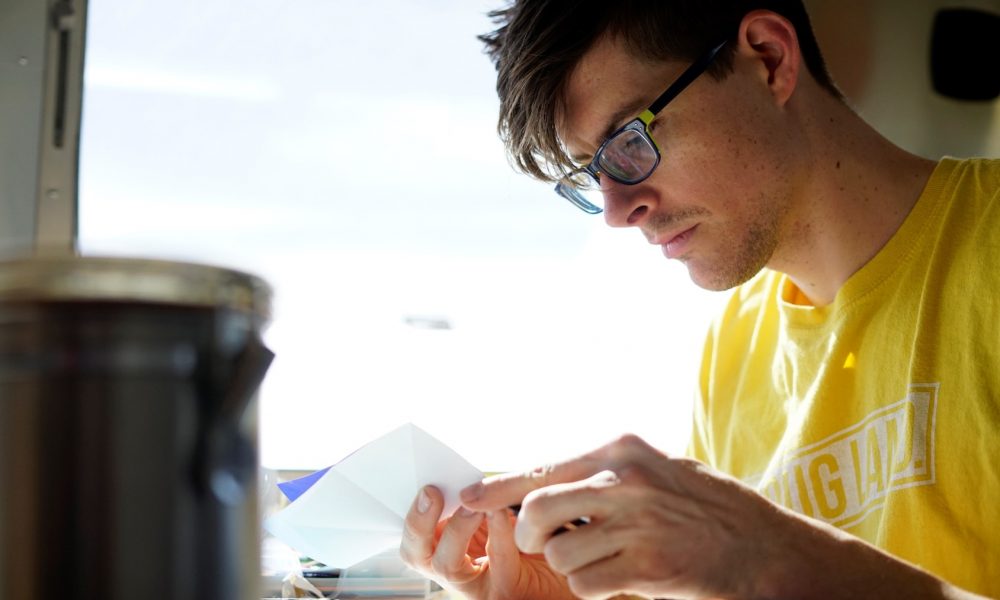
Today we’d like to introduce you to Doug Land.
Thanks for sharing your story with us Doug. So, let’s start at the beginning and we can move on from there.
I grew up in the once wooded parts of Cedar Hill, before the city decided that since trees don’t pay taxes, they’d have to go. The woods that I played in, were paved over for food buffets and a rotation of ‘closing’ businesses, and big box stores. That loss of freedom to roam the fields and woods of my childhood left an impression on me. When I went to SCAD (Savannah College of Art and Design) for Illustration I noticed that I kept drawing scenes and landscapes that I was familiar with, perhaps to recreate the parts of my childhood memories that were sold away.
After graduation, I came back to Cedar Hill, and couldn’t find any work, so I ended up in Cape Cod–a world completely different to north Texas. I was living near the sea, working in a museum and doing handyman repairs around town. The museum put me in contact with a lot of different artists. I helped them set up their shows, and do all the cool ‘art-things’ that I dreamt of doing when I was in college.
I moved back to Cedar Hill again after 2 or 3 years in Cape Cod. I still had a hard time finding work. I thought that I would try working in another museum, except this time, I was a museum guard for the DMA. It was hands down the most boring job and the most inspiring job. I stood around famous works of art all day long studying every brushstroke and every hammered nail and sketching everything that inspired me. I would talk to anyone that wanted to look at my sketchbook, even the Museum Director. It was truly a limiting job, but I made the most of it. From the DMA, I went to the Perot, where they let me take apart and repair pretty much everything the guests broke (even some of the dinosaurs). It was at the Perot where I learned how to make art withstand the abuse of public’s inquisitiveness. Now I work at Cris Worley Fine Arts, where I have learned a ton about the intricacies of selling art and shipping it too. Each job has taught me, how to make my art better. Some jobs gave me books to read, and others put tools in my hands, but I had to figure out how to make my own art, and that was the hardest job of them all.
Has it been a smooth road?
Coming out of art school and finding out that art actually needs to run like a business has not been an easy journey! I’m a working artist, with a resume that is better measured in yards instead of pages. Since I graduated with my first degree in Illustration, and I’ve been back and forth to college in order to learn as much as I can about electronics and rapid prototyping (which is, in my opinion, the future of art). Every art show I take on, forces me to learn a new skill set and a new set of tools. I’m making art that I don’t see in books, and therein lies my other problem–selling the art I make. Currently a large portion of my income pays for supplies and tools, or I salvage what I can from artworks that didn’t sell. For the most part, I’m pretty organized with each build that I take on, and I spend a lot of time between spreadsheets of itemized parts that I need to build an artwork and sourcing out the cheapest vendor for a part (a skill that I learned at the Perot). Lastly I have a lot of friends and family that want to see my dreams become reality, and they help me out the most. Whether it’s helping me sew 500 flowers on a canvas or helping me haul scrap acrylic between studios.
So let’s switch gears a bit and go into the Doug Land story. Tell us more about the business.
Lately my artwork has taken to root in botany (pun intended). Artistic rendering of botanical forms using industrial materials. I’ve been taking industrial materials, a lot of which come from Home Depot. I manipulate the material, until I get a surprisingly natural form. Currently I am working on a residency at Tarrant County College-South Campus with Joshua Goode (who is also an exhibiting artist), where I’m making a set of wind-powered rotating cacti from corrugated sheet metal as a part of an installation and a show that opens in January 2019.
How do you think the industry will change over the next decade?
Dallas is a unique market unlike Houston, and even unlike Fort Worth. I think that all the new transplants to the city will have a huge shift in the type of work that gets collected. It is hard to say whether these newcomers to Dallas will accept or reject the plethora of galleries and artworks that Dallas has to offer. I hope that these new Dallasites will be captivated by our strong (and growing) art scene. Our local scene is a wonderful amalgamation of historical crafts, cultural influence, and a city that constantly recycles its history in the name of progress. Local organizations and the community have made great strides to push the local artist. And you start to really see this influence in the corporate collections and public art commissions throughout the city. The challenge for us artists is getting out to as many art openings as possible, with the goal of meeting new faces and making new connections.
Contact Info:
- Website: http://doug.land/
- Phone: (505) 303-0771
- Email: dig@doug.land
- Instagram: https://www.instagram.com/doug.land/
- Facebook: https://www.facebook.com/dougdotland/
- Twitter: https://twitter.com/dougdotland


 Image Credit:
Joshua Landrith
Getting in touch: VoyageDallas is built on recommendations from the community; it’s how we uncover hidden gems, so if you know someone who deserves recognition please let us know here.